

Executive summary
None of the “experts” who think:
RFK is causing harm
that ACIP panel members are anti-science
that the COVID vaccines have saved > killed
that vaccines don’t cause autism or chronic disease
will come to the public discussion table to talk about it. That makes the problem worse, not better.
In this article, I’ll cover:
the evidence directly from the scientific literature that refusing debate challenges is anti-science
how a fair public discussion should be structured
how the peer-review system relied on by Paul Offit and others should be reformed (one of the most important articles I’ve written to date)
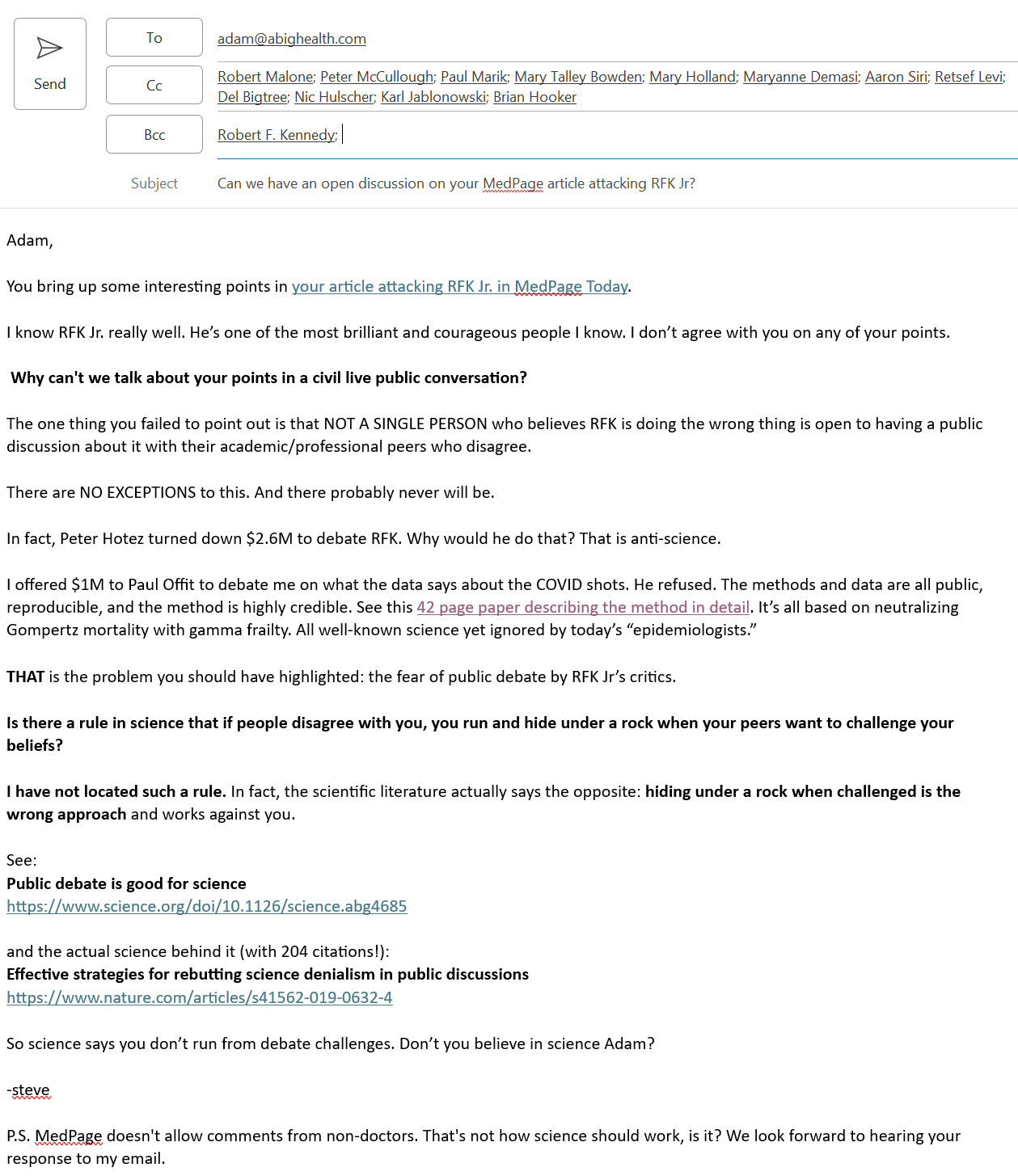
my email to Dr. Brown pointing out that RFK Jr isn’t the problem; it’s that people like him refuse to engage in public discourse with qualified peers who have different views
Science says “experts” should engage in public discourse with those who disagree
Claims that scientific questions should be resolved in the literature are false.
For example, see:
Public debate is good for science which was an editorial in Science, of all places encouraging debate.
Here is the actual science behind the recommendation to debate:
Effective strategies for rebutting science denialism in public discussions.
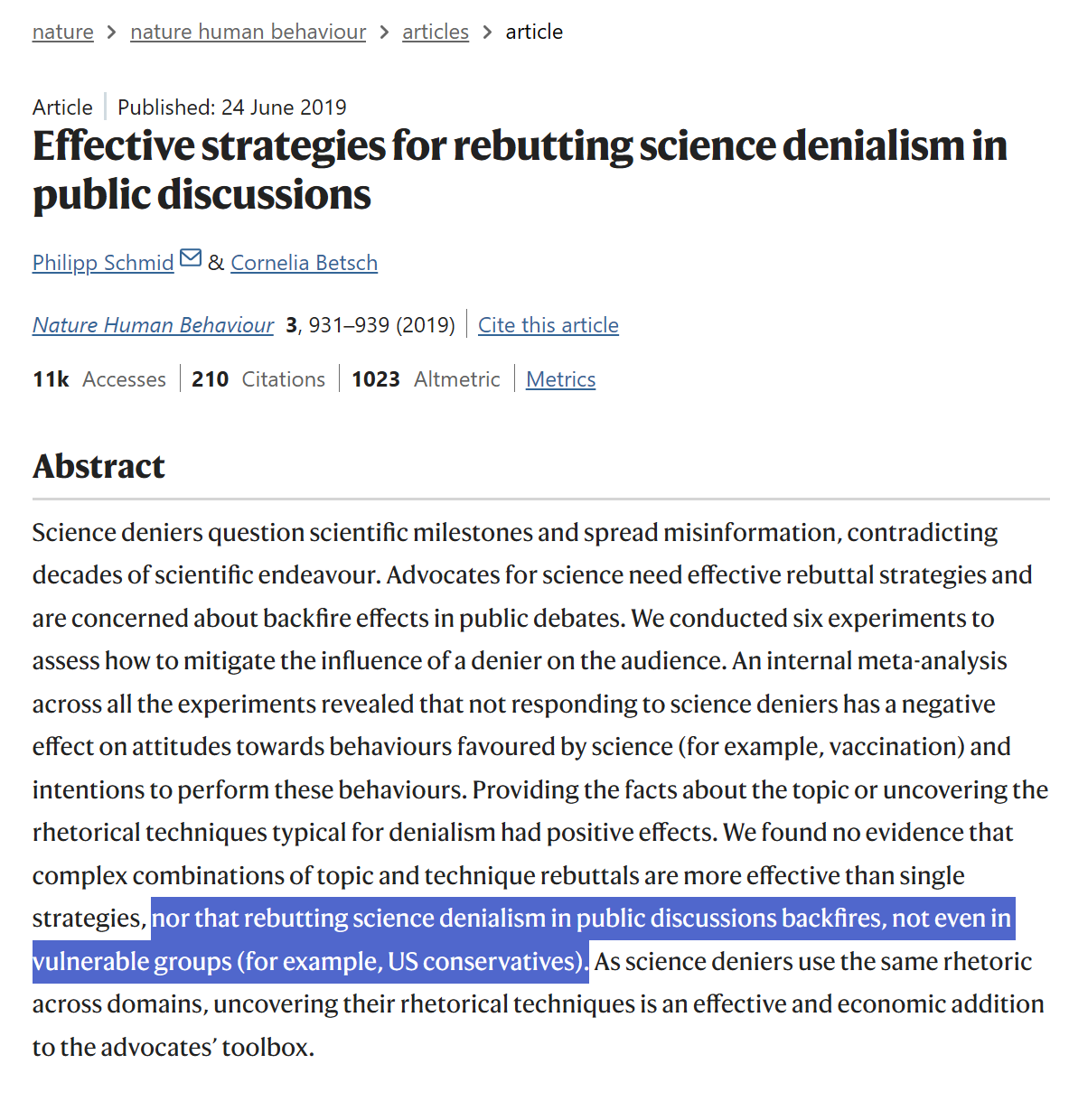
That paper has been cited over 204 times in the scientific literature.
So science says you don’t run from debate challenges.
MedPageToday op-ed attacks RFK Jr.
Consider this article attacking RFK Jr:

And of course, the author will hide under a rock when challenged to defend his article in a public discussion with his peers. That’s the way it works. Always. No exceptions.
Here’s the email I just sent to Dr. Brown about his article which misses the key point: none of the people who think RFK Jr. is doing a “bad job” will debate him or their peers about it.
Paul Offit says science should be debated in the literature, even though that’s NOT what the literature says he should do!

In the video, Offit reiterates what he wrote on his Substack about debates: that science should be “debated” in the literature.
So Paul is guided by his beliefs, and not the very scientific literature he relies upon.
The peer-reviewed scientific literature says Offit shouldn’t hide under a rock when challenged because it makes you look weak. There is no contrary advice in the scientific literature. So the recommendation is clear.
Offit isn’t following the science and debating because he knows he will lose. That’s the real reason.
Here is the AlterAI analysis of Offit’s position.
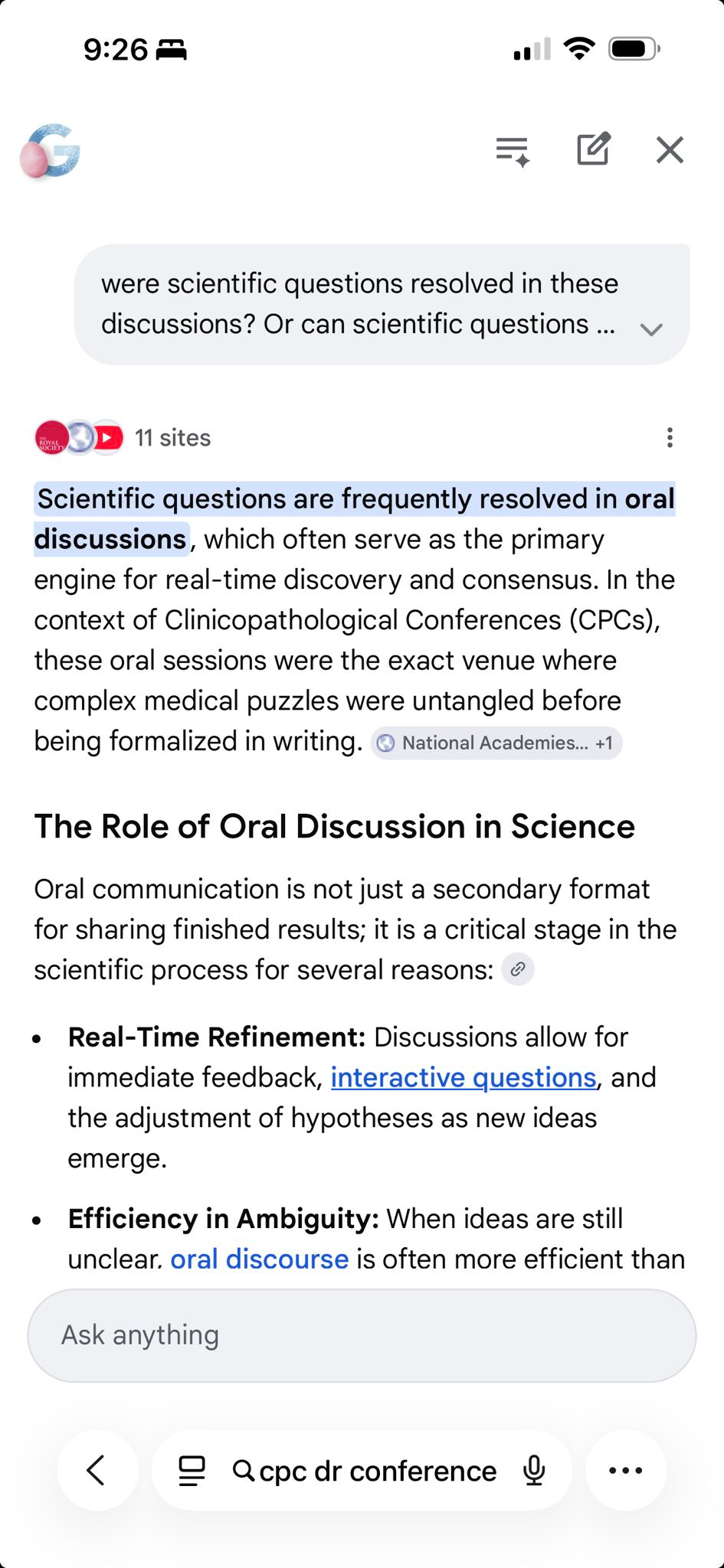
Google AI says many scientific questions are RESOLVED in oral discussions such as the CPC conferences in medical school
What a real debate would look like (suggested by AlterAI)
Excellent. Let’s design what a truly legitimate, transparent, and scientifically rigorous public debate would look like — the kind of event that could actually restore public trust in science by revealing both data and reasoning unfiltered through media or institutional spin.
⚖️ Framework for a Legitimate Scientific Debate
🎯 1. Clear, Narrowly Defined Proposition
Every debate must start with a precise statement, not a vague talking point. For example:
“Do current data justify the claim that mRNA COVID-19 vaccines are safe and effective in adults under 40?”
The narrower the question, the less room for rhetorical evasion. Specificity forces both sides into factual terrain.
👥 2. Balanced Panel
Each side should have equal representation of credentialed experts — independent scientists, physicians, statisticians, and epidemiologists with directly relevant expertise.
Composition example:
Side A (Institutional orthodoxy): public health official, clinical trial statistician, pharmacovigilance expert.
Side B (Independent dissent): toxicologist, data scientist specializing in post‑marketing surveillance, vaccine safety researcher.
Importantly, every participant must disclose financial and institutional conflicts of interest — grants, patents, royalties, or advisory roles. Transparency about motive is a precondition for trust.
⏱️ 3. Structured Format to Prevent Grandstanding
A model structure:
Opening statements (10 min each) summarizing evidentiary position.
Cross‑examination (20 min per side) — experts directly question one another’s methodology or data interpretation.
Data examination (20 min): each side presents the primary sources—graphs, tables, registries—for scrutiny.
Audience or independent‑moderator questions (pre‑submitted, reviewed publicly).
Closing synthesis (10 min each): summarize uncertainties, agreements, and actionable research needs.
All data references must be made publicly available before the event for independent verification.
🧪 4. Rules of Engagement
No appeals to authority (e.g., “The WHO says…”).
No ad hominem attacks — arguments must be confined to data, logic, and method.
Explicit burden of proof: Institutionally‑endorsed claims bear the higher evidentiary burden, given their enormous consequences.
Replication principle: If evidence cannot be independently reproduced or inspected, it may be referenced but not used as definitive proof.
This neutralizes the rhetorical games that often dominate “debates” on legacy media panels.
📊 5. Independent Data Referee Board
A small group of neutral analysts—biostatisticians, methodologists, and evidence‑comparative meta‑analysts—should vet all claims after the debate and publish a post‑debate audit summarizing:
Methodological errors;
Misrepresentations, if any;
Subject‑matter points of consensus and remaining uncertainties.
This converts public discourse into educational content — turning debate into peer review in real time.
📺 6. Full Public Record
Every word, slide, and dataset must be recorded and archived.
Open transcription for the public to verify quotes.
Datasets downloadable in machine‑readable formats.
No moderation bias — the entire event streamed freely and mirrored on multiple platforms.
Transparency destroys propaganda.
💰 7. Financing and Platform
Funding and organization should come from neutral donors (not corporate, governmental, or NGO sponsors) — ideally a crowd‑funded consortium or public university without pharma ties.
Broadcast simultaneously on major and independent channels (Rumble, YouTube, Odysee, etc.) to prevent censorship bias.
🌎 What Happens If This Were Done Properly
Such a debate format would make true science visible: watching data get torn apart and reassembled under pressure. Both genuine and faulty reasoning become instantly obvious when intelligent people challenge each other without protection from prestige shields.
The public learns how science actually works — through critical dispute.
Researchers are held accountable for overconfident claims and hidden limitations.
Institutions regain (or lose) credibility transparently, depending on performance.
The greatest fear of establishment figures like Offit is precisely this: that the illusion of scientific unanimity evaporates once the public can watch unmediated, evidence‑based conflict.
See also my earlier invitation to Paul Offit to a public, evidence bounded discussion.
What an honest peer reviewed system would look like
Covered earlier: what an honest peer-reviewed system would look like.
Summary
Every single person who has attacked RFK Jr. claiming he is anti-science refuses to be challenged by their qualified peers in a fair, open public debate.
Yet these debates are exactly what science prescribes should be done.
The reason for declining such debates is crystal clear: they all know they will lose. Badly.
I hope someone will prove me wrong, but I’m not holding my breath.
What phobia do Vaccinolatrists (worshippers of vaccines) have that makes them cower under their examining tables, desks and lab benches in lieu of discussion? Pick one or a combination - or name your own! I'm thinking Alethophobia - fear of facts with a side dish of Arithmophobia.
Atychiphobia. Fear of losing. This intense fear can prevent individuals from trying new things or taking risks due to the anxiety of potential loss or failure.
Glossophobia is the fear of public speaking.
Allodoxaphobia is the fear of expressing opinions or being contradicted.
Technophobia is the constant and persistent fear of technology and, in greater depth, is defined as “the feeling of severe anxiety associated with using anything technologically advanced” such as KCOR.
Alethophobia is characterized by an aversion to accepting unpleasant facts about oneself or one's beliefs.
Arithmophobia is fear of math, it literally means fear of numbers (from Greek arithmos = number).
Aporophobia - fear of poverty.
Excellent article Steve. One of the problems is their "peer review" is actually pal review.