

Executive summary
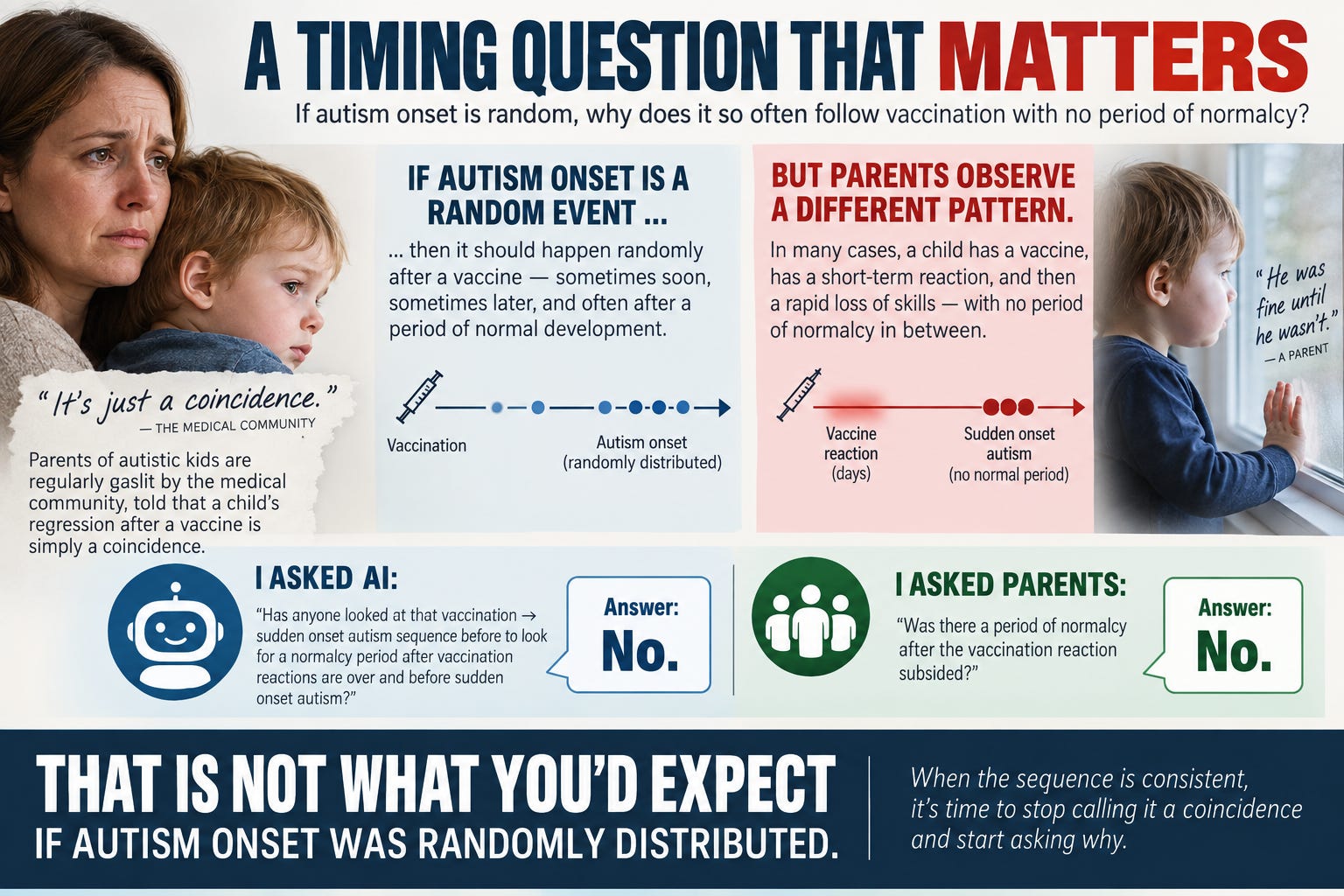
Parents of autistic kids are regularly gaslit by the medical community, saying that the child’s regression proximate to a vaccine was simply a coincidence.
If autism onset is a random event, then it should happen randomly after a vaccine.
I asked AI the key question that would resolve this:
Has anyone looked at that vaccination —> sudden onset autism sequence before to look for a normalcy period after vaccination reactions are over and before sudden onset autism?
Answer: No.
So I asked parents of suddenly autistic kids what they observed. Was there a period of normalcy after the vaccination reaction subsided?
Answer: No.
That is not what you’d expect if autism onset was randomly distributed
Secondly, a neutral recruitment into an autism research study done over 20 years ago showed more than 2/3 of the parents had the belief that their child’s autism was caused by vaccines.
Nobody has ever explained why that number is so large if autism is random. Ever.
Because it sure isn’t an advertising campaign done by any anti-vaccine group prior to 2003!
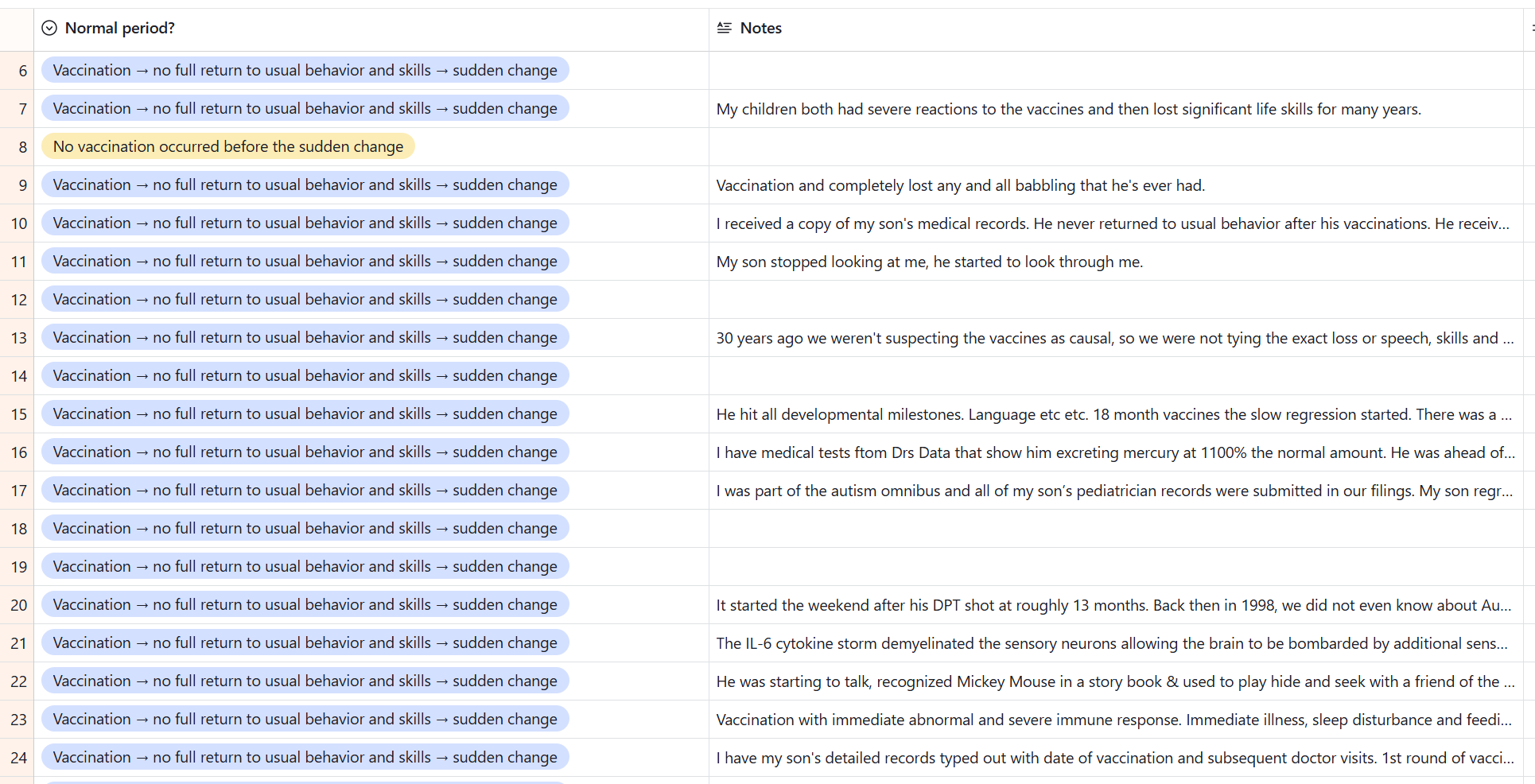
Survey: Was there a “normal period gap” post vaccination and before onset? Answer: No!
Parents of children with sudden-onset autism often report a sequence of:
normal child —> vaccination—> fever—> Tylenol given—> autistic child
I was curious if a period of normal behavior ever preceded “autistic child.”
The answer appears to be yes, but it was less than 24 hours, and happened in just 2 out of 39 reports.
Here is the survey and the survey results.
In other words, the autism onset is part of the full sequence starting with vaccination. It’s a causal sequence, not a random event.
If autism were random around the time of vaccination, there would be a random number of normal days in between vaccination effects (fever onset/Tylenol) ending and onset. There wasn’t. It’s basically a tight linked sequence.
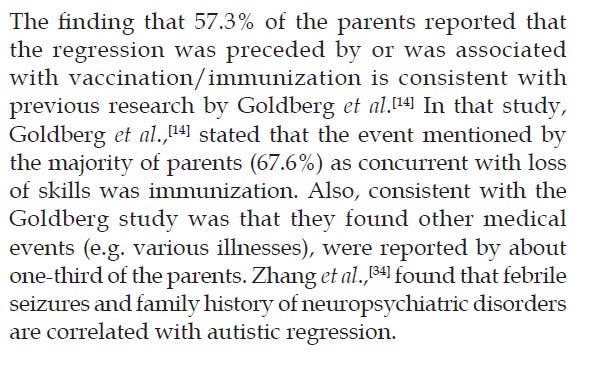
Goldberg study (2003)
The Kern 2014 paper notes that Goldberg et al. (2003) recruited neutrally and found that 67.6% of parents reportedly mentioned immunization as concurrent with loss of skills.
A neutral recruitment into an autism research study done over 20 years ago showed more than 2/3 of the parents had the belief that their child’s autism was caused by vaccines. If it was just a coincidence we might expect fewer than 20% of parents to make that association (assuming vaccination is given every 90 days and a parent makes the connection of autism happens within 18 days of the shot).
2/3 of parents in 2003 is attributing the cause to vaccines is inexplicable because the parents are gaslit by the pediatricians to believe that it’s just a coincidence and parents totally trust the pediatricians and totally think that vaccines are safe (because otherwise they wouldn’t have vaccinated their kids in the first place).
So how can two-thirds of parents make that attribution if vaccines don’t cause autism?
Nobody has ever explained that. Ever.
Summary
The data collected from parent observations is fully consistent with “vaccines cause autism” and nobody seems to be able to credibly explain how the two points I made above are consistent with the null hypothesis.
I’m still waiting.
I’ve heard so many sad stories like this that it’s time we do something. Vaccines are horrible and no parent should put them on their children.
However, if, for whatever reason, a parent decides to allow vaccinations, they need to the risks that come with it and what they can do to protect themselves. Document, document, document so you can go after these manufacturers: https://unorthodoxy.substack.com/p/a-black-friday-gift-that-could-actually
The burden of proof is on the autism creators. If the proximity of Autism, SID or other serious adverse effects from the vaccination is a coincidence, a "black swan" event which has no connection to the vaccinations recently given, they must provide the evidence to support this assertion. Where are the studies? Where is the clinical evidence? What is the scientific basis for calling it a random event? We all know their answer to these questions: they have no answer.