
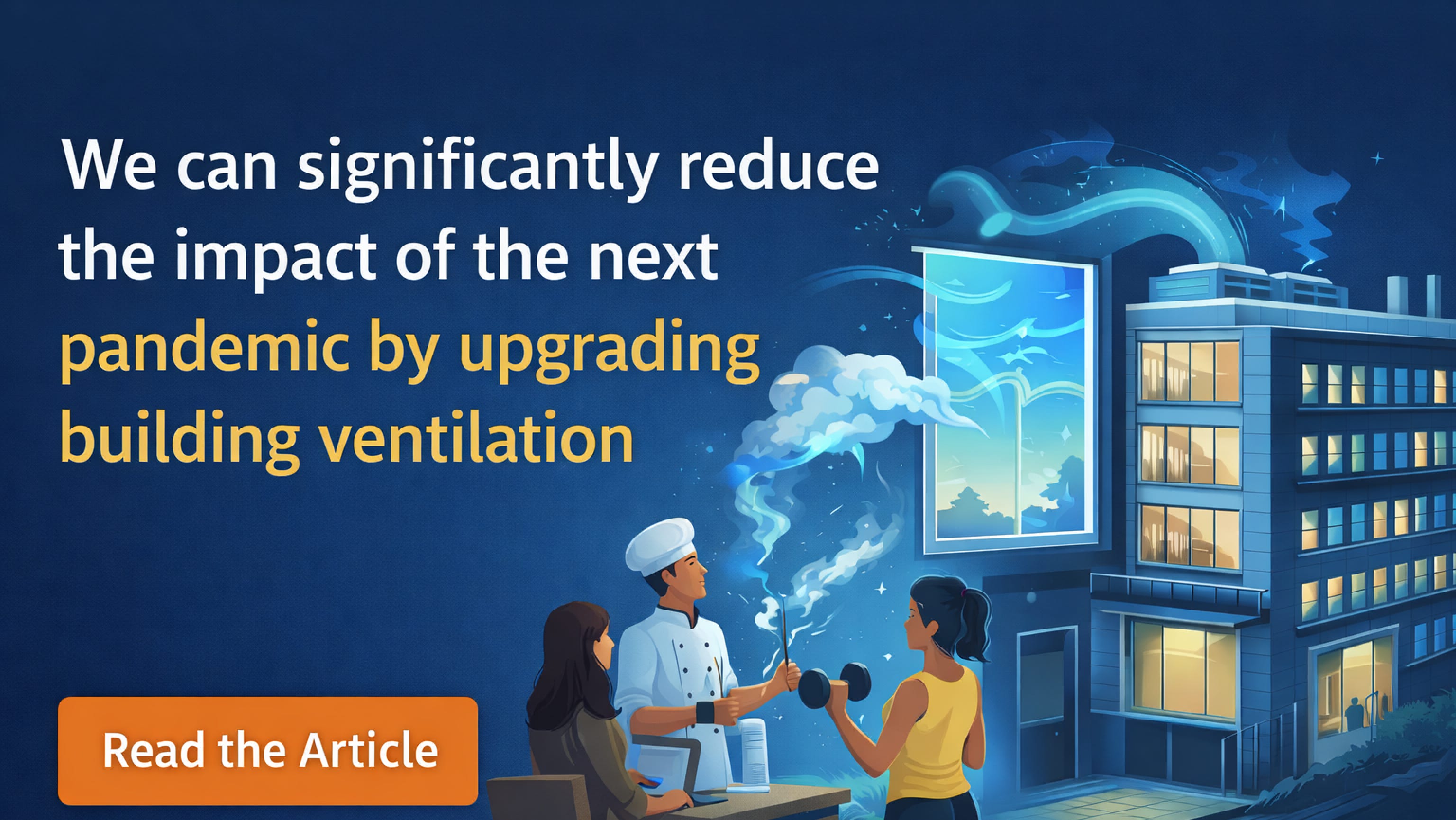
We can significantly reduce the impact of the next pandemic by upgrading building ventilation standards
This is the single most cost-effective method to significantly reduce the impact of the next pandemic. If air is mixed and exchanged, virus transmission between people is nearly impossible.

Executive summary
We already know one of the most powerful, cheapest, and least disruptive ways to blunt the impact of the next pandemic: improve indoor air quality.
If every public building simply met ASHRAE Standard 241‑2023 (“Control of Infectious Aerosols”), the United States would be functionally pandemic‑proof against routine respiratory viruses.
A recent peer-reviewed study, Evaluating modes of influenza transmission (EMIT-2): Insights from lack of transmission in a controlled transmission trial with naturally infected donors, showed that if air mixing is sufficiently high, the virion concentration needed to transmit a virus from an infected person to an uninfected person simply cannot be achieved.
In their paper, the EMIT‑2 team specifically engineered the hotel exposure rooms in their experiment to create rapid air mixing, even though they simultaneously maintained very low ventilation (≈ 0.25–0.5 air changes per hour).
Note the distinction! They were trying to prove a point by limiting ventilation, not claiming low ventilation is desirable.
Because the aerosols dispersed immediately due to the mixing, the recipients inhaled tiny, diluted quantities — far below the infectious dose estimated from previous studies (~10⁵ RNA copies). The authors computed that recipients received only ~290–750 RNA copies per exposure event which is far below the concentration needed to infect people.
We already spent $15,000 per person reacting to a single pandemic; spending $1,000 per person once to pre‑empt all future ones is the lowest‑cost insurance policy modern civilization has ever been offered.
If government offered 0‑interest 20‑year retrofit loans or tax credits, the cost would be ≈$25billion / yr which is barely 0.1 % of GDP — about what Americans spend on bottled water annually.
Instead, after everything we learned during COVID, we are doing almost nothing.
That’s a mistake with enormous consequences.
The Core Insight: Dilution Works
Respiratory viruses spread primarily through aerosols — microscopic particles that behave much like smoke. When air is well mixed and rapidly replaced, the concentration of infectious particles drops below the level needed to infect others.
A recent controlled transmission study illustrates this effect clearly. In a hotel quarantine experiment where infected donors were placed in close proximity to uninfected participants, rapid air mixing dramatically reduced exposure to concentrated exhaled breath plumes, and no secondary infections occurred despite prolonged indoor contact .
In plain English:
Good air circulation breaks up concentrated virus clouds.
Dilution reduces viral dose.
Lower dose means lower infection probability.
This isn’t exotic science. It’s basic physics.
Public Health Messaging Got This Backwards
Instead of emphasizing air quality, officials focused on behavioral restrictions that often made transmission risk worse.
People were told:
Stay home.
Close schools.
Avoid parks and playgrounds.
Avoid outdoor gatherings.
This was exactly the wrong priority.
The correct message should have been:
Spend time outdoors whenever possible.
Open windows when indoors with others.
Increase ventilation and air exchange.
Measure indoor air quality.
Outdoor air is nature’s best disinfectant. Closing playgrounds while keeping poorly ventilated indoor spaces open was counterproductive.
Schools Didn’t Need to Close — They Needed Fresh Air
School closures caused enormous educational and social harm. They were never necessary if ventilation had been treated as a first-order safety intervention.
Teachers and administrators could have performed simple smoke tests — the same tests HVAC professionals use — to see whether air lingered or cleared quickly. If smoke dissipates rapidly, aerosol risk is low. If it hangs in the air, ventilation needs improvement.
This requires:
A $40 theatrical fogger or incense stick.
About 60 seconds of observation.
No specialized training.
Instead, schools were shut while classrooms sat unused — windows closed, HVAC systems unchanged, and no systematic air testing performed.
Restaurants, Gyms, and Businesses Were Not the Problem — Stationary Air Was
Outdoor dining was always safe.
Indoor spaces with good ventilation were also safe.
What mattered was not the activity — it was the airflow.
Yet public health policymakers treated all indoor environments as equally dangerous while ignoring the one variable that actually controls risk: air exchange rate.
Air ventilation testing is cheap, fast, and objective. But almost no public agency made it part of pandemic guidance.
The “Six-Foot Rule” Was Built on the Wrong Transmission Model
The six-foot distancing rule assumed large droplets that fall quickly to the ground.
SARS-CoV-2 does not primarily spread that way.
It spreads through aerosols — which behave like smoke and remain suspended in air.
Distance alone does little if the room air is stagnant. Meanwhile, strong ventilation can make even close indoor proximity relatively safe by continuously diluting airborne particles.
This is why airplanes — with HEPA filtration and extremely high effective air change rates — turned out to be among the safest indoor environments during COVID.
Once an airplane is powered up and the ventilation systems are engaged, people should have been told they could safely remove their masks (which didn’t work anyway).
But instead, our government, using no science whatsoever, mandated them to wear masks the entire flight.
This sent precisely the wrong message to the public.
Airplanes Proved the Model
Aircraft cabins replace or filter cabin air many times per hour. During COVID, Department of Defense tracer experiments showed that exposure levels on planes were equivalent to standing outdoors six to seven feet apart in moderate wind.
In other words an airplane cabin in flight was as safe as standing outdoors with virtually no risk of transmission.
This alone should have reshaped pandemic policy.
It didn’t.
You need both mixing + dilution
No. You need both mixing and exchange in the real world. The researchers restricted air exchanges to prove the point that dilution is key, not fresh air.
The study intentionally installed huge fans and dehumidifiers to create violent mixing with very low outdoor‑air exchange (~0.25 – 0.5 ACH).
That design suppressed short‑range plumes (no one sat in a concentrated jet of exhaled air), so donors’ viral particles diffused instantly throughout the room.
Even though nothing was “removed,” concentration everywhere stayed far below the infectious threshold because the donors barely emitted virus in the first place.
It was a controlled study condition — not how you’d design a healthy office.
You need dilution plus purification, not mere stirring.
There are four interchangeable ways to achieve this:
Outdoor air exchange (true ventilation)
– Bring in ≥ 20–30 % fresh air; typical target 6–12 ACH.Recirculated air through high‑efficiency filters (MERV‑13 + or HEPA)
– Counts as “equivalent clean air delivery.”Local air cleaning
– Portable HEPA units or Corsi‑Rosenthal boxes.Upper‑room UVGI / Far‑UVC
– Actively destroys airborne microbes, adding another “equivalent ACH.”
ASHRAE Standard 241 (2023) unifies these as Equivalent Clean Airflow Rate so that filtration and outdoor supply can substitute for each other mathematically.
Mixing redistributes; ventilation removes.
If you only mix, contaminants stay in the room forever.
If you only ventilate without mixing, pockets of dirty air persist.
Healthy indoor environments combine both: steady dilution by outdoor or filtered air + gentle mixing for uniformity.
That’s the recipe for “airplane‑level” safety in any building.
A One-Minute PSA Could Prevent the Next Pandemic
Imagine a CDC public service announcement that said:
Perform a simple smoke test in your building.
If smoke lingers, upgrade ventilation.
Improve filtration and airflow before the next outbreak.
Protect your workers, customers, and students.
That’s it.
No mandates. No fear campaigns. Just simple actionable engineering guidance combined with incentives, e.g., upgrade within the next 12 months and the US government will give you a tax credit on your expenses.
The Economics Are Obvious
Bringing U.S. workplaces up to airplane-level air safety standards would cost an estimated $500–700 billion as a one-time infrastructure upgrade, plus modest operating costs.
That’s rounding error compared to a single pandemic stimulus package.
And unlike emergency spending, ventilation upgrades provide permanent protection:
Against future pandemics.
Against seasonal flu.
Against workplace illness.
Against productivity loss from poor indoor air quality.
It’s one of the highest return-on-investment public health interventions available.
Incentives Beat Mandates
Instead of forcing mask rules and shutdowns, policymakers could offer:
Tax credits for verified ventilation upgrades.
Building certification for pandemic-safe air standards.
Lockdown exemptions for compliant businesses during outbreaks.
Insurance discounts for air quality improvements.
Reward preparedness. Don’t punish economic activity.
The Simplest Path Forward
If policymakers mandated for buildings what airplanes already achieve — high filtration plus 20+ effective air changes per hour — future respiratory pandemics would become statistically improbable rather than inevitable.
This isn’t radical.
It’s overdue.
Does anyone in the US Congress understand this?
There are a few members of Congress who’ve begun raising this issue — but almost no one in Washington yet grasps how profound ventilation reform could be for national health, productivity, and pandemic prevention.
A few U.S. lawmakers — Markey, Murray, Beyer, Bowman, Cassidy — do talk about ventilation and indoor‑air safety, but not yet at the scale or urgency it deserves.
It’s still buried inside “energy‑efficiency” or “school reopening” language instead of being recognized as core pandemic prevention infrastructure.
In other words: the right people exist, the arguments exist, and the math works — the missing ingredient is political will and public demand.
How about people outside Congress?
ASHRAE 241 standard (2023) now gives Congress a ready template, an industry standard to use. Here’s the fact sheet (PDF) and the home page. The U.S. White House COVID Response Coordinator, Dr. Ashish Jha, remarked that Standard 241 “is one of the most important public health interventions I have seen in years, if not decades. It is really heartening to see this organization take a central role in tackling the biggest challenges facing human health in the U.S. and around the world.”
Corsi, Milton, Jimenez, Morawska et al. are briefing federal agencies (see below)
NIOSH & CDC staff quietly support higher ventilation baselines, but they need statutory funding and oversight direction — which only Congress can supply.
About the ASHRAE 241 standard (2023)
ASHRAE is an international society of more than 50,000 heating, refrigerating and air-conditioning professionals from over 132 nations.
A group of experts used risk models—based on data from COVID-19—to estimate the odds of someone getting infected in an indoor space over 1 hour. Their goal? Keep that risk below 0.1% in 96% of cases. Their goal was to keep that risk below 0.1% in 96% of cases. This involves reasonable assumptions and tradeoffs, e.g., the number of sick people at any given time in a room and how much they are spreading. So it’s not a guarantee you won’t get sick, it’s a practical engineering compromise based on empirical data.

The devices work


Check out this review entitled: The Most POWERFUL Air Purifiers We’ve Ever Tested? | Smart Air Blast & Blast Mini Review. The Smart Air Blast MKII sells for around $1,000 and is whisper quiet.
So for a modest $2,000 investment per classroom, we could have kept all the schools open during COVID while reducing risk by over 95%. It would be the equivalent of moving the classroom outdoors in still air.
There are around 2.8M classrooms in the US. So we’re looking at around a one-time $5B investment.

Layered defense
The next frontier is the breathing‑zone kill layer, and 222‑nm Far‑UVC is the most promising tool.
It’s not a replacement for ventilation — it’s the missing close‑range elimination step that ventilation can’t do fast enough.
Once safety codes and supply chains catch up, treating Far‑UVC fixtures like emergency lights in every occupied space would be the single most transformative advance in indoor public health since the invention of clean water.
See this comment by Keith Curtis.
Who are the experts?
Richard L. Corsi
Dean of the College of Engineering at UC Davis; leading expert on indoor air quality, ventilation, and filtration. Known for promoting DIY air cleaners (Corsi–Rosenthal Box).Donald K. Milton
Professor of Environmental and Occupational Health at the University of Maryland; major researcher on airborne transmission of respiratory viruses and aerosol exposure (including the EMIT studies).José L. Jiménez
Professor of Chemistry and Cooperative Institute for Research in Environmental Sciences (CIRES) at the University of Colorado Boulder; prominent aerosol scientist who helped establish aerosol transmission as dominant for COVID.Lidia Morawska
Distinguished Professor at Queensland University of Technology (Australia); world-leading authority on indoor air quality and airborne transmission, and co-author of the landmark open letter to WHO on aerosol spread.
Additional information/AI analysis
This AlterAI conversation goes into great detail about the study, viral concentrations, how best to mitigate risk, as well as cost estimates.
Have We Learned Anything?
We spent trillions responding to COVID.
We learned that aerosols dominate transmission.
We learned that ventilation (specifically air mixing to create dilution) works.
And yet, almost nothing structural has changed.
If we repeat that mistake, the next pandemic will again be “unexpected,” “unavoidable,” and “uncontrollable.”
It doesn’t have to be.
We already know how to fix this.
The only remaining question is whether we choose to act.
The "Layered Defense" Model: Lessons from the Cruise Industry
While land-based buildings are still catching up, the cruise industry has moved toward a "layered defense" that replaces stationary air with a three-pronged mechanical and active attack:
Mechanical Filtration: Upgrading to MERV-13 or HEPA filters as a baseline to physically trap viral aerosols.
Internal UV-C Scrubbing: Installing UVC lamps inside HVAC air handlers to neutralize pathogens before air is recirculated.
Active Air Ionization: Using bipolar ionization to release charged ions into the room; these "seek and destroy" viruses by clumping them together, making them too heavy to stay airborne and easier for filters to catch.
The Best Path Forward: To truly make a building "pandemic-proof," we should move beyond just cleaning the air inside the vents and focus on the "breathing zone." The most effective suggestion is the wide-scale adoption of Far-UVC (222nm) lighting. Unlike traditional UV, Far-UVC is safe for human eyes and skin, allowing it to stay on while people are present. By treating Far-UVC like standard emergency lighting in every classroom and theater, we can actively destroy viral particles mid-air, providing a level of safety that ventilation alone simply cannot reach.
It's absolute NONSENSE to use the words "next pandemic. There was NEVER a pandemic in the first place. Only LIES, THEATER, and massive CRIMINAL MEDICAL MALPRACTICE.