

Executive summary
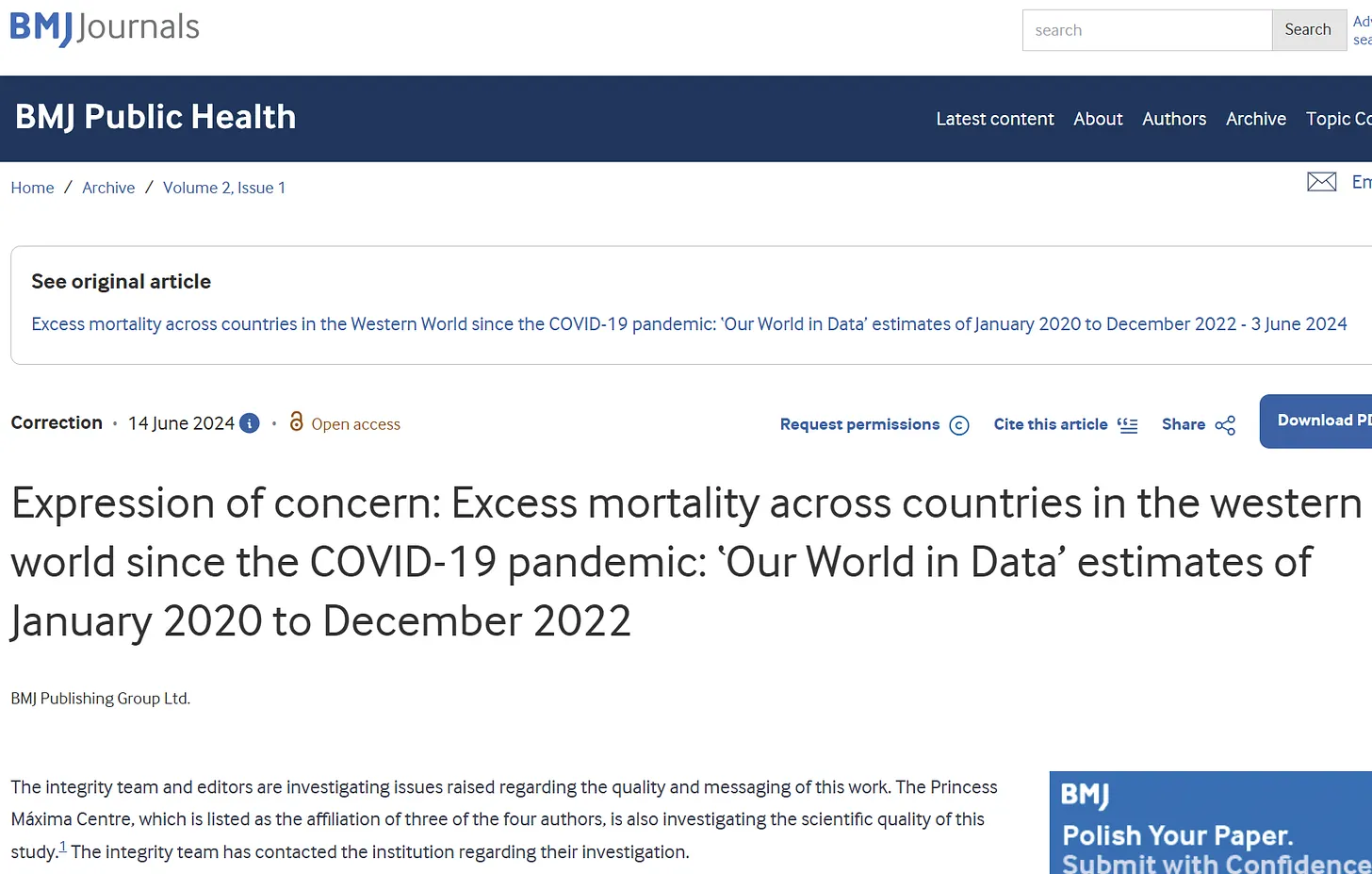
For more than 2 years now, both the integrity team and editors at BMJ public health have been investigating “issues” raised regarding the quality and messaging in the Mostert paper which showed excess deaths rose in 47 countries after the COVID vaccines rolled out.
After more than two years, the “issues” with the paper have not been revealed.
Here is the press release. Here is the result of the investigation.
The investigation confirmed what was obvious from the start:
The data is real
The methodology is standard
The authors did nothing fraudulent
The institution just didn’t like the political implications of being associated with a paper that called the safety of the COVID vaccine into question
This is not a scientific integrity problem. This is a textbook example of why people no longer trust institutional science to answer uncomfortable questions honestly.
It appears to me that they are fixing the process so that any papers which question vaccine safety will never be published again.
What is legitimately baffling now is:
They say the authors thought their own paper was misleading and they asked the BMJ to retract it. Huh?!? Why they would spend so much time in the paper showing why the COVID vaccine could be a potential cause of the excess deaths if all of them believed that it couldn’t possibly be the cause of the excess deaths?
Why didn’t they spend any time in the paper explaining how they determined that the vaccine could NOT be the cause of the excess deaths? They spent a large part of the paper showing why it was plausible.
We still don’t know what data and science convinced the authors of the paper that the vaccine couldn’t possibly have been a contributing factor in the excess deaths because they didn’t disclose that in their paper. Why?
They need to reveal that.
I am working with their press relations in order to surface that information. I will report here when I hear back from them as to what evidence the authors had that rules out the vaccine as a possible cause of the excess deaths and why they withheld it.
Neither the teams of integrity expert and editors BMJ nor the Princess Maxima Center have found any errors in the paper. Nor have they explained what caused the excess deaths to peaked worldwide right rollouts of the COVID primary and booster shots.
The paper concluded that excess mortality remained high despite the rollout of mitigation measures. That’s not contestable.
“Government leaders and policymakers need to thoroughly investigate underlying causes of persistent excess mortality.”
That sounds like sound advice as well.
Yet, the Princess Maxima Centre is NOT calling for any investigation into the causes of the excess deaths which are uncontestable. Don’t they want to know why so many people died?
Government leaders are also avoiding the investigation.
BMJ's policy is generally to wait for the home institution's formal finding before retracting, so the journal effectively handed the decisive step to the Princess Máxima Center.
We need to know exactly why the authors of the paper spent so much time on detailing why the vaccine could potentially be the cause of the excess deaths if they had ruled out the possibility that the vaccines could cause excess deaths.
It is legitimately baffling.
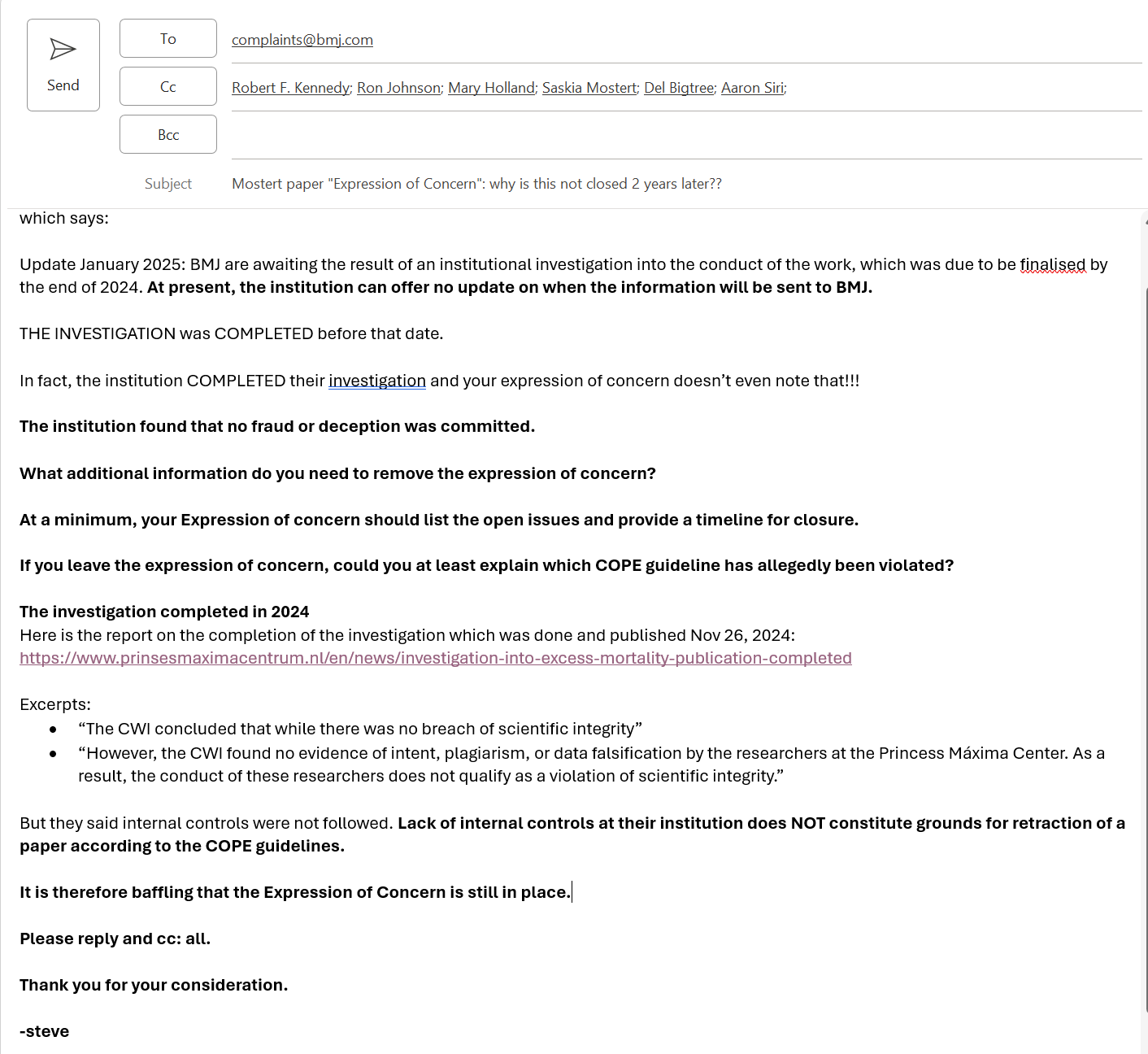
My email sent Jun 23, 2026 to the BMJ complaining about why as of Jun 23, the paper is still listed as Expression of Concern
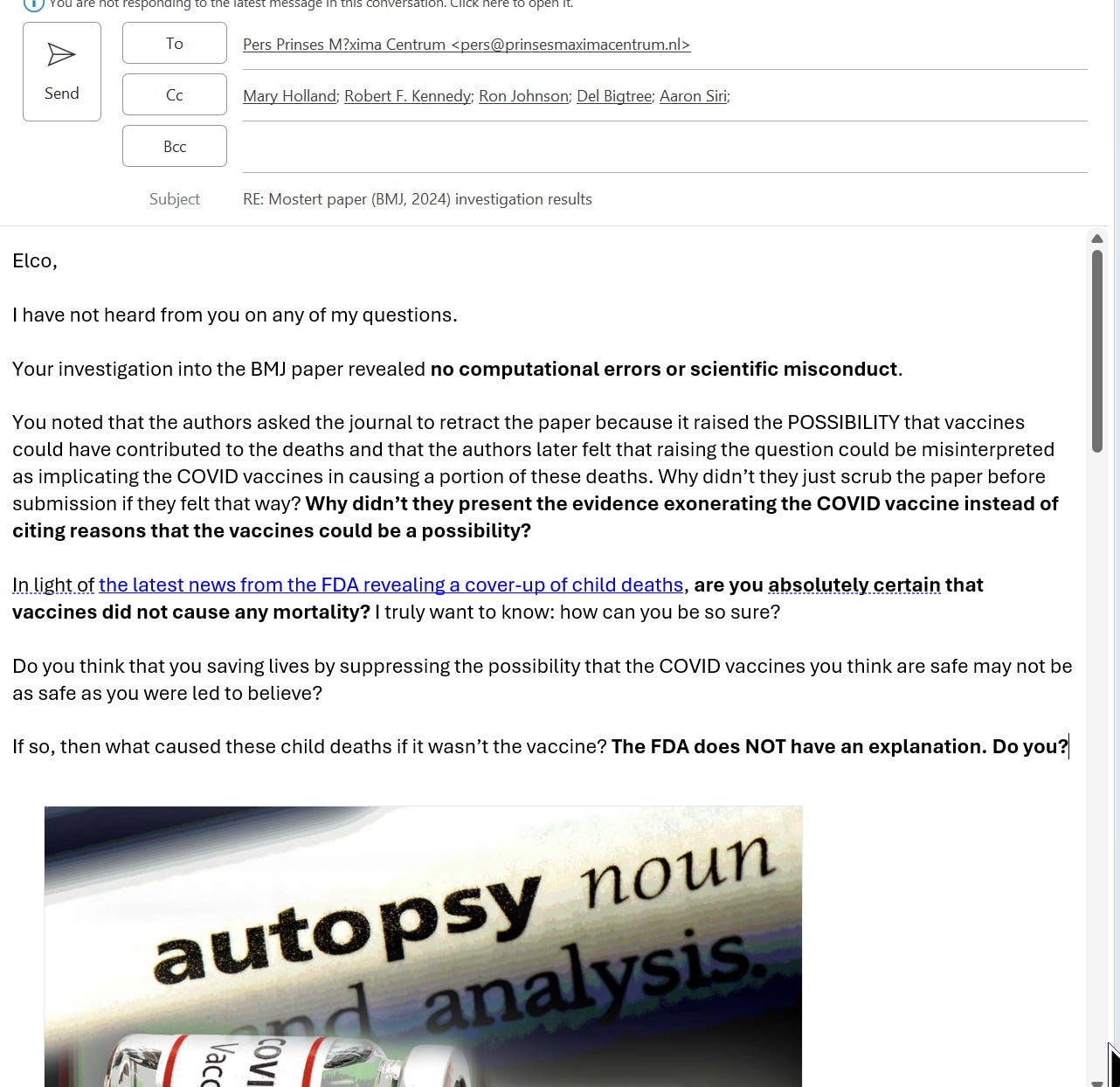
My email to Princess Maxima Center
They don’t seem to want to answer any of my questions for some reason.
The email refers to the FDA investigation of child deaths.
Mostert paper conclusions
Here’s the key graph for 47 countries in the Western World. It went above the trendline only after the COVID vaccines were introduced (both primary shots and booster shots).
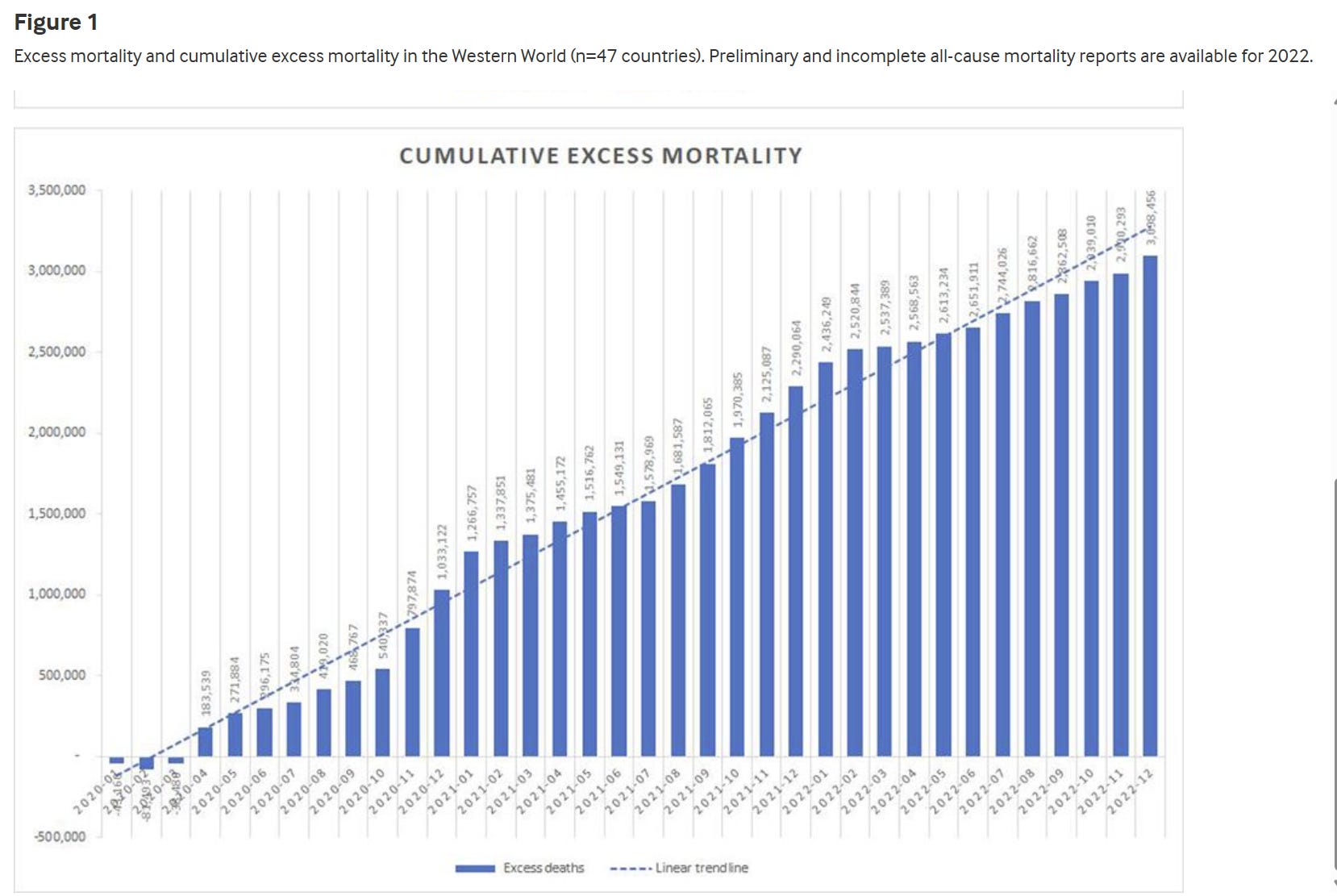
Results The total number of excess deaths in 47 countries of the Western World was 3 098 456 from 1 January 2020 until 31 December 2022. Excess mortality was documented in 41 countries (87%) in 2020, 42 countries (89%) in 2021 and 43 countries (91%) in 2022. In 2020, the year of the COVID-19 pandemic onset and implementation of containment measures, records present 1 033 122 excess deaths (P-score 11.4%). In 2021, the year in which both containment measures and COVID-19 vaccines were used to address virus spread and infection, the highest number of excess deaths was reported: 1 256 942 excess deaths (P-score 13.8%). In 2022, when most containment measures were lifted and COVID-19 vaccines were continued, preliminary data present 808 392 excess deaths (P-score 8.8%).
About the P-score
A P-score is a way of expressing excess mortality in relative (percentage) terms rather than raw counts. It’s the metric Karlinsky and Kobak introduced in their World Mortality Dataset work, which is the baseline model Mostert et al. used.
The formula is straightforward:
P-score = (observed deaths − expected deaths) / expected deaths × 100%
So it’s the percentage by which actual deaths exceeded (or fell short of) the number you’d expect under normal pre-pandemic conditions. A P-score of 0% means deaths landed exactly at the expected baseline. A P-score of 11.4% (the figure Mostert reported for 2020) means about 11.4% more people died than the model predicted would have died absent the pandemic. A negative P-score means fewer deaths than expected.
The “expected” number is the key modeling choice. It’s a projection of how many deaths there should have been in a given week or month, built from historical mortality in prior years and typically adjusted for trends like population aging and seasonality. Karlinsky and Kobak fit a regression on pre-2020 data to generate that counterfactual baseline.
Why use a P-score instead of raw excess death counts: it normalizes across populations of very different sizes. Saying “Country A had 50,000 excess deaths and Country B had 5,000” tells you little if A is ten times larger. The P-score puts everyone on a common percentage scale, so a 10% P-score in a small country is directly comparable to a 10% P-score in a large one. That’s what makes it useful for the kind of cross-country comparison Mostert was doing across 47 countries.
A P-score of 13.8% is a substantively large excess
When you roll out mitigation measures such as vaccines and lock downs, excess deaths are supposed to go down after the roll out, not up.
The fact that after the mitigation measures, things got worse is what the paper is pointing out.
Summary
The Princess Maxima Centre is silent on what is wrong with the paper and the correct way to analyze the data.
It’s been two years.
They owe us an update, not removal of their webpage.
I have reached out to their press contact and will update you on their response.
Don’t hold your breath.
Steve and Wayne, that link doesn't go to the wayback machine. Here's the first snapshot they took of that page:
https://web.archive.org/web/20240611235016/https://www.prinsesmaximacentrum.nl/en/news-events/news/the-princess-maxima-center-distances-itself-from-publication-excess-mortality-during-covid-19-pandemic
And here's what they wrote on that page:
[Blah blah blah]...
Originally, the idea was to look at the effect of COVID measures on, among other things, the mortality rate of children with cancer in low-income countries. During the course of the study, the focus shifted and diverted in a direction that we felt was too far from our expertise: pediatric oncology. We are not experts in epidemiology, nor do we want to give that impression. The Máxima Center therefore emphatically distances itself from this publication. We should have been more alert to the formation and results of this publication and will further investigate the way it was created. If it turns out that carelessness was involved in the realization of this publication, it will of course be withdrawn.
We, as the Princess Máxima Center, want to emphasize that we strongly support vaccination, and that this publication should certainly not be read as an argument against vaccination. The study in no way demonstrates a link between vaccinations and excess mortality; that is explicitly not the researchers' finding. We therefore regret that this impression has been created.
The paper is wrong because the results are unwanted. Simple as that. The Science® has spoken.