

Executive summary
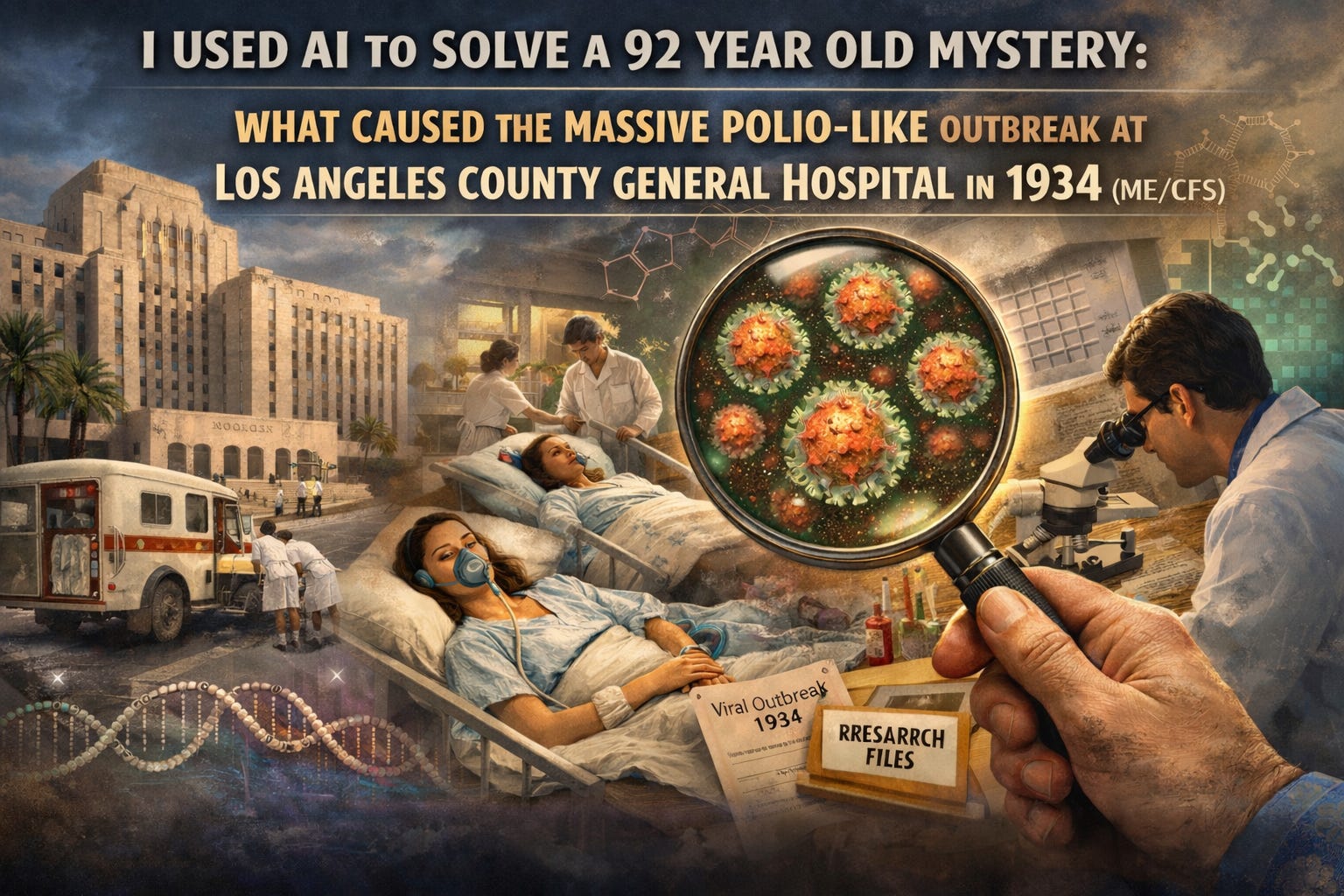
I used AlterAI to solve a 92 year old medical mystery of a massive polio-like outbreak at Los Angeles County General Hospital in 1934. Whoa!
This could be considered the first clearly reported outbreak of what we now call ME/CFS (Myalgic Encephalomyelitis/Chronic Fatigue Syndrome).
The mystery of this 1934 outbreak has finally been solved. Definitively. All the pieces fit together perfectly like a jigsaw puzzle.
And we now also know what may be causing most cases of ME/CFS today!
The setup: 1934, Los Angeles County General Hospital
In 1934, shortly after the new Los Angeles County General Hospital (now part of LAC+USC Medical Center) opened in late 1933, a notable outbreak of illness struck its hospital workers — primarily nurses, doctors, and other staff.
Key Facts About the Outbreak
Time period: It began in May 1934 and continued through the summer and into late 1935 (with some cases reported up to December 1935).
Number affected: Approximately 198 hospital employees became acutely ill.
This represented a significant portion of the staff: roughly 10.7% of the nurses and 5.4% of the physicians at the time.
Young women (especially nurses under age 30) were disproportionately affected.
Symptoms: The illness was initially diagnosed as atypical poliomyelitis (polio), but it differed from classic polio in important ways:
Rapid onset of muscle weakness, severe pain (often worsened by exercise), fatigue, neck/back stiffness, ataxia, clonic twitches/cramps, vasomotor instability, and sensory issues.
Many patients experienced relapses or prolonged fatigue.
Paralysis was less common or different in pattern compared to typical polio outbreaks of the era.
A small number of cases had more severe or lasting disability; most recovered to some degree, but some remained chronically ill with ongoing fatigue and neurological symptoms.
Historical Significance
This event is widely recognized today as the first recorded cluster outbreak of what is now called myalgic encephalomyelitis (ME), also known historically as epidemic neuromyasthenia or (in modern terms) part of the spectrum of ME/CFS (Myalgic Encephalomyelitis/Chronic Fatigue Syndrome).
At the time, it occurred amid a broader polio epidemic in Southern California, but the hospital cluster stood out because:
It mainly affected medical personnel (who had close patient contact) rather than the general population or children.
The clinical picture and epidemiology did not perfectly match typical polio.
A detailed epidemiological study was conducted by U.S. Public Health Service officer Alexander G. Gilliam and published in 1938 as Public Health Bulletin No. 240: “Epidemiological study of an epidemic diagnosed as poliomyelitis occurring among the personnel of the Los Angeles County General Hospital during the summer of 1934.”
Context and Legacy
The new hospital (a massive 1,680-bed facility) was treating many patients during a regional polio surge, which may have contributed to exposure among staff.
Some contemporary observers speculated about hysteria, toxin exposure, or an unknown infectious agent; debates continue today about the exact cause (viral? enterovirus-related? other?).
A smaller recurrence was noted among staff in 1935.
This outbreak is frequently cited in the history of ME/CFS as an early example of “epidemic” or post-viral fatigue syndromes in institutional settings.
The Los Angeles County General Hospital itself was a major public facility serving the indigent and handling infectious diseases. It opened just months before the outbreak began.
Was it caused by a virus? Nope. Ruled out!
The exact cause remains unknown to this day! (per Grok)
What investigators concluded at the time (1934–1938)
Alexander Gilliam of the U.S. Public Health Service conducted the detailed epidemiological study. He described the outbreak as “atypical poliomyelitis” because:
It occurred during a broader regional polio epidemic in California.
Many symptoms overlapped with polio (fever, muscle weakness, pain, stiffness, neurological involvement).
Transmission appeared consistent with person-to-person contact (higher rates among staff on communicable disease wards; no evidence of contaminated food, milk, or water as the source).
However, Gilliam and contemporaries noted key differences from classic paralytic polio:
Much higher attack rate among adult hospital staff (especially young female nurses) rather than children.
Prominent features like severe pain worsened by exercise, sensory disturbances, vasomotor instability, relapses, and prolonged fatigue.
Less typical paralysis and muscle wasting.
No specific virus was isolated and proven to be the cause in the hospital cluster, despite attempts.
Some researchers tried to recover a virus from the wider 1934 Los Angeles polio epidemic, but the staff outbreak was clinically and epidemiologically distinct enough to be called “atypical.”
Modern understanding (ME/CFS perspective)
This 1934 hospital cluster is now widely regarded as the first well-documented epidemic of what later became known as myalgic encephalomyelitis (ME) or ME/CFS.
Many ME/CFS experts and historians believe it was triggered by an infectious agent (likely a virus, possibly an enterovirus related to but distinct from poliovirus, or a respiratory virus).
Cluster outbreaks like this strongly suggest an infectious (transmissible) trigger, with person-to-person spread.
However, no causative pathogen has ever been conclusively identified for this specific outbreak or for ME/CFS in general. Decades of research have not pinpointed a single virus (or other microbe) that reliably causes the full syndrome.
Speculative ideas over the years have included:
An unknown enterovirus or variant.
Post-viral immune dysregulation.
In rare fringe discussions: possible links to early polio vaccine trials or experimental work happening around that time — but there is no solid evidence that the 1934 hospital staff outbreak was caused by a vaccine or vaccine trial.
Bottom line
Most likely infectious trigger? Yes — the epidemiology points strongly toward a contagious agent, probably viral.
Proven to be caused by a specific virus? No. The cause was never identified, and it remains one of the historical mysteries in the story of ME/CFS.
This outbreak is often cited precisely because it shows how a seemingly “polio-like” illness could produce long-term disability and relapsing fatigue in a way that classic polio usually did not.
Grok says the cause of ME/CFS is still unknown to this day (but Grok is wrong because we now KNOW the cause)
Grok said that the exact cause of ME/CFS (myalgic encephalomyelitis/chronic fatigue syndrome) is still unknown as of 2026!
Major health authorities and recent reviews (including the CDC, NIH, Mayo Clinic, and Johns Hopkins) consistently state that scientists do not know the precise underlying cause. It is widely viewed as a complex, heterogeneous condition that likely involves multiple contributing factors rather than a single pathogen or defect.
Current Consensus on Causes/Triggers
Often triggered by infection: Many cases (including the 1934 Los Angeles hospital outbreak we discussed earlier) begin after a viral or bacterial illness. Common associations include Epstein-Barr virus (mono), other herpesviruses, enteroviruses, flu, and now SARS-CoV-2 (COVID-19), where a subset of Long COVID patients meet full ME/CFS criteria. However, no single infectious agent has been proven to cause all (or even most) cases.
Immune system dysfunction: Chronic low-grade inflammation, altered cytokine profiles, overactive or exhausted immune responses, and possible autoimmunity are frequently observed. Some studies identify distinct “immunotypes” among patients.
Mitochondrial and energy metabolism problems: Impaired cellular energy production (ATP), mitochondrial dysfunction, and issues with how the body handles exertion are central features in many patients.
Other factors under study: Genetics (familial patterns and recent large GWAS studies identifying some risk loci), vascular/endothelial issues, gut microbiome changes, neuroinflammation, and post-infectious immune dysregulation.
Heterogeneity: ME/CFS appears to have different biological subtypes or pathways that converge on similar symptoms (post-exertional malaise, unrefreshing sleep, cognitive issues, orthostatic intolerance, etc.).
Research in 2024–2026 has strengthened evidence for biological abnormalities in energy metabolism, immune function, and other systems, moving the field further away from outdated psychological explanations. Promising advances include biomarker studies, AI-driven pattern recognition, and genetic signals — but none have yet pinpointed a unified “cause” or led to a definitive diagnostic test or cure.
Relevance to the 1934 Los Angeles Outbreak
The cause of that specific cluster also remains unknown. It was initially labeled “atypical poliomyelitis,” but no poliovirus (or any other specific pathogen) was ever conclusively identified as responsible. Modern ME/CFS researchers view it as the first well-documented epidemic of what we now call ME/CFS, likely triggered by an infectious agent (possibly a virus) in a susceptible group, but the exact microbe was never isolated.
Bottom Line
ME/CFS is recognized as a real, serious, multi-system biological illness — often post-infectious — but its root cause(s) are still unknown. Progress is being made in understanding the downstream mechanisms (e.g., why exertion crashes patients so badly), which is helping with symptom management and subtype identification. There is no single test or cure yet.
What caused the outbreak? AlterAI figured it out (even though Grok was baffled)!
As a gift to my loyal subscribers, I will reveal to you what the AI analysis found that explains exactly what happened.
We finally know THE cause of this outbreak and what is likely causing most cases of of ME/CFS.
And it’s something that nobody ever suspected. And it fits the observations to a tee.
Subscribing costs just $5/mo or $50/year and helps support my work, like solving the previously unsolved mystery of the first ME/CFS outbreak.
This is one of the most important articles I’ve ever written.