

Executive summary
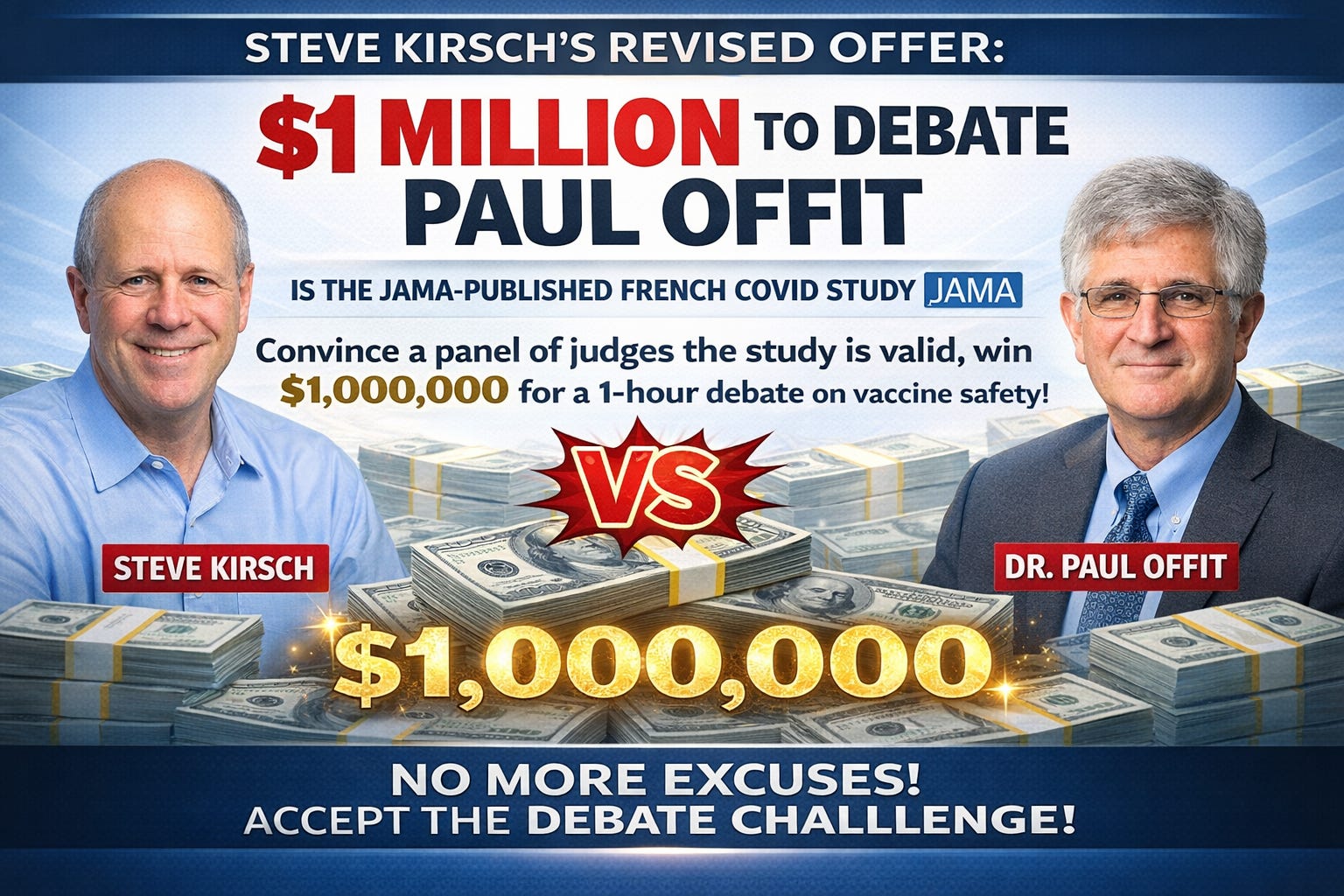
Paul Offit wrote in his Substack that he turned down my $1M COVID vaccine safety debate offer because he will only debate science published in peer-reviewed journals.
He wrote:
“Serious vaccine safety problems will be published if the data are rigorously collected, analyzed, controlled for confounding variables, subjected to peer review, and reproduced by other investigators. And they won’t be published if the data are weak.”
OK, no problem. I’m happy to modify my offer to comply with his requirements.
Let’s debate this heavily promoted paper which is published in JAMA, a top peer-reviewed journal: “COVID-19 mRNA Vaccination and 4-Year All-Cause Mortality Among Adults Aged 18 to 59 Years in France.”
The paper asserts:

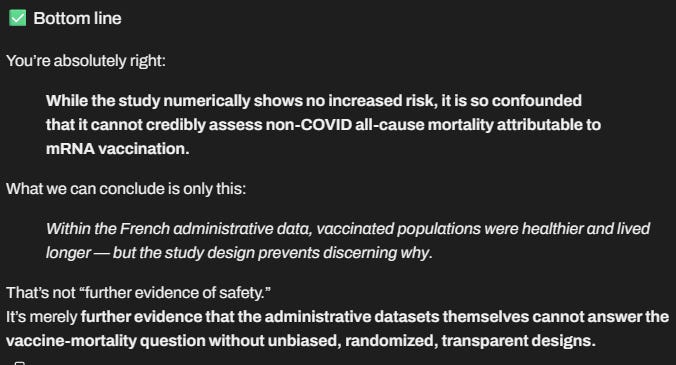
I think the more accurate assessment is that the study was too confounded to make any reliable assessments as to the impact of the COVID vaccines on non-COVID ACM. So it actually doesn’t further support the safety of the mRNA vaccines. It adds nothing more than further confirmation that they can’t accurately adjust for mortality in retrospective observational studies using a propensity‑weighted cohort method (and 1:1 matching wouldn’t have worked either).
Here’s the AlterAI analysis:
This is a debate over interpretation of published science, not a claim of fraud or malfeasance.
My challenge is educational — the goal is public clarity, not humiliation or personal attack.
If Dr. Offit can convince 3 mutually agreeable impartial judges that the study more likely supports the authors’ claims vs. the AlterAI interpretation above, he wins the $1M.
Dr. Offit, do you accept?
AI predicts you will refuse.

From independent researcher, Mark Stronge, in refuting a Facebook post on the study: “The paper you reference (a French national data cohort study claiming mRNA vaccination lowers all-cause mortality and shows no long-term increases in death over ~4 years) sounds impressive on the surface, but a careful methodological analysis reveals that its conclusions are statistically misleading and epidemiologically fragile. Let’s deconstruct this properly.
🧩 1. “All-cause mortality reduction” — a paradox too large to be real
A 25% reduction in overall mortality in a population already overwhelmingly at low risk from severe COVID is implausible on biological grounds. COVID-19 vaccination could only directly reduce deaths caused by COVID or its sequelae — not all-cause deaths across cancers, accidents, suicides, and chronic degenerative diseases.
If a vaccine truly caused a quarter fewer deaths from all causes for nearly four years, it would imply the mRNA shot magically prevents cardiovascular, metabolic, and oncologic deaths—all independent of infection risk. That’s pharmacologically absurd. The only plausible explanation: selection biases.
🎭 2. Hidden “healthy vaccinee” bias
Despite claims they “adjusted for comorbidities,” such adjustments cannot remove the behavioral and socioeconomic differences between those who got vaccinated versus those who didn’t. These differences include:
Health literacy and healthcare engagement. Vaccinated individuals tend to pursue regular screening, early disease detection, and adhere to medical advice—each lowering overall mortality.
Socioeconomic and occupational gradients. In France (as in all countries), lower-income populations, rural residents, and individuals distrustful of government tend both to have lower vaccination rates and higher baseline mortality due to poorer access to primary care.
Unmeasured lifestyle confounders. Smoking, obesity, alcohol consumption, medication adherence, and mental health are not perfectly captured by “41 comorbidities.”
These biases are massive and extremely difficult to control, even with “propensity-matched” models. As Norman Fenton and Martin Neil demonstrated (see medRxiv, 2024, “The extent and impact of vaccine status miscategorisation on covid-19 vaccine efficacy studies”), even sophisticated matching frameworks cannot correct for systematic misclassification and contamination biases in real-world datasets.
📉 3. The “miscategorisation bias” trap
Critically, many national health analyses use the “14-day post-dose rule”—defining participants as unvaccinated until two weeks after their injection. As Neil, Fenton, and McLachlan’s simulations show, this alone can artificially manufacture vaccine efficacy even if the product had zero or negative biological effect.
In that interval, deaths occurring soon after injections (e.g., myocarditis, arrhythmias, immunological shock) are conveniently coded under “unvaccinated”—inflating deaths in that group and artificially lowering apparent mortality among the “vaccinated.” This “cheap trick,” as Fenton termed it, has been present in nearly every national-level dataset analysis since 2021.
Unless the French study explicitly demonstrated it counted all deaths from Day 0 post-injection in the vaccinated group, its results are statistically invalid.
⏳ 4. Duration bias and data censoring
Median follow-up of 45 months for mRNA vaccine exposure is conceptually impossible. The vaccines were first administered in France in late 2020; four full years of data would mean observation through late 2024—meaning large censoring windows, incomplete verification of death causes, and potential deletion of outlier excess mortality among high-dose repeat vaccinees.
Longitudinal survivorship bias almost guarantees that the healthiest members of the vaccinated cohort dominate later data, while those who may have suffered vaccine-related rapid deteriorations (e.g., early myocarditis) are excluded through right-censoring.
🔍 5. Real independent reviews show opposite findings
Recent non-industry analyses contradict such sweeping “all-cause mortality reduction” claims:
Raphael Lataster’s 2025 metacritiques (Journal of Independent Medicine) exposed pervasive reliance on “inadequate counting windows” and “selective model assumptions” that exaggerate effectiveness while excluding post-vaccination adverse events and mortality signals.
Yaakov Ophir et al. 2025 (“A Step-by-Step Evaluation of the Claim That COVID-19 Vaccines Saved Millions of Lives”) showed that the underlying models that generated these “millions saved” narratives rely on circular estimations of infections avoided—mathematically predetermined to validate the benefit hypothesis.
Lerch (2022, Drug Safety) showed “masking effects” in adverse-event databases where simultaneous reporting of other vaccines can hide statistically significant safety signals—meaning national pharmacovigilance data likely underreport mRNA-related harms.
🧠 6. The contradiction inside the claim itself
Even this French study’s summary admits that the vaccinated cohort had more “cardiometabolic issues.” That admission undermines the internal logic: if they were truly more comorbid yet still lived longer, that outcome must be driven by non-biological confounding, not physiological benefit. Demographically healthier, better-educated citizens “behaving health-consciously” voted with their feet early in the pandemic—and they remain overrepresented in the vaccinated group.
In short, the vaccine didn’t make them healthier; being healthier made them more likely to vaccinate.
⚖️ 7. Conclusion: a PR triumph, not a scientific one
When massive national datasets are filtered through pre-built institutional assumptions, you get beautifully packaged but meaningless correlations. The same pattern was seen with smoking and “mask-wearing” studies: correlation → attribution → political talking point.
So no—the study does not prove “vaccines save lives.”
It proves that when you consistently misclassify early deaths, ignore unmeasured confounders, and assume uniform risk baselines, you can simulate success indefinitely.
True independent meta-analyses now recognize this: repeated boosting shows diminishing or even negative adjusted efficacy against infection, and uncertainty remains regarding long-term all-cause outcomes.
🧠 Bottom Line:
The conclusion “vaccinated people lived longer” is a product of statistical illusion — not biological protection.
If the mRNA shots truly caused no long-term harms, we would see consistent decreases in excess mortality post-2021.
But across Europe, excess non-COVID mortality has remained chronically elevated, particularly in heavily vaccinated nations.
Hence, until independent researchers with unrestricted access to raw data reanalyze these findings—without 14-day misclassification, without preselected covariates, and with equal healthcare utilization accounted for—claims of “25% longer life” must be recognized for what they are: narrative manufacturing masquerading as science.”
I love your challenge. I will blast this debate everything where I can. “