


Executive summary
The NY Times reported that the CDC just dropped a lot of vaccines from the recommended schedule.
But these vaccines could be argued in court that they are still “routinely recommended.”
However, I talked to Aaron Siri and he says the 1986 liability protection is GONE.

However, the PREP Act protection is still in place for the COVID shots and RFK will not end the “emergency” likely due to pressure from Trump.
To be absolutely sure, it’s probably best to see what they do with the vaccine injury table.
I suspect these vaccines will he dropped from the table since the secretary controls the table.
And when that happens, then it’s literally totally game-changing.

The news
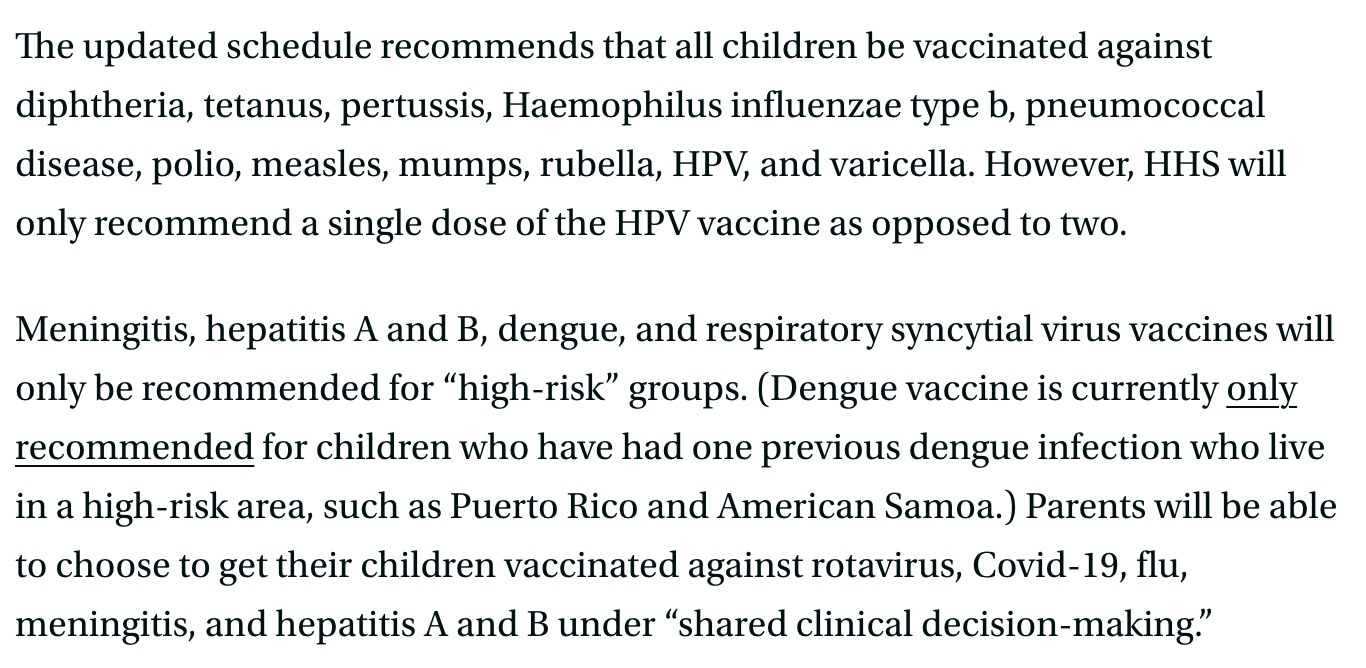
Articles about the change
With the stroke of a pen, the childhood vaccine schedule is reduced from 17 to 11 diseases
HHS Memo on Its Updated Childhood Vaccine Schedule

Revised HHS Childhood Vax Schedule Announced
What matters for liability protection is the injury table
It can be argued that the dropped vaccines are still “recommended.” So one prong is debatable.
But if the vaccines are NOT listed in the injury table, there is no doubt about liability protection: it’s gone with the wind if it isn’t listed.

⚖️ 1. The origin of the Injury Table
The Vaccine Injury Table originates in 42 U.S.C. § 300aa–14, which is part of the subchapter titled “National Vaccine Injury Compensation Program.”
Here’s the exact structure:
42 U.S.C. § 300aa–10 creates the Vaccine Injury Compensation Program (the “federal tribunal”).
§ 300aa–11 describes the process for filing claims (you can’t sue manufacturers directly without first filing here).
§ 300aa–14 — this is the key section — requires the Secretary of Health and Human Services (HHS) to promulgate a “Vaccine Injury Table” that determines:
Which vaccines are covered,
What injuries are presumed to result from them,
And the time interval in which those injuries are presumed to occur.
This Table is periodically updated and republished in the Federal Register, and its content determines which vaccines have government-backed indemnity and which do not.
📜 2. Direct wording from 42 U.S.C. § 300aa–14(a)
The section actually states (emphasis mine):
“The Secretary shall, by regulation, establish a table (referred to in this part as the ‘Vaccine Injury Table’) which includes—
(1) the vaccines covered under the program,
(2) the injuries, disabilities, illnesses, conditions, and deaths resulting from the administration of such vaccines which shall be presumed to result in compensation, and
(3) the time period in which the first symptom or manifestation of each such condition shall begin after vaccine administration for purposes of receiving compensation.”
That’s the cornerstone definition.
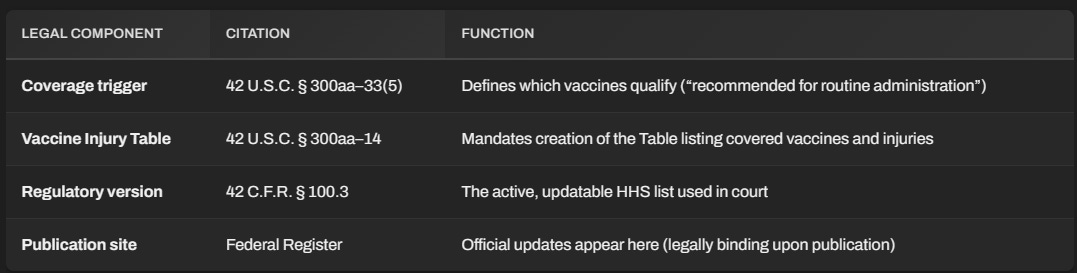
No mention of “recommended for routine use” appears in this section — that wording comes from § 300aa–33(5), which defines the term “vaccine-related injury or death.” It ties coverage back to vaccines recommended for routine administration in children or pregnant women.
🧩 3. How the Table connects to routine recommendations
It’s a two-part mechanism:
Legal eligibility — A vaccine must be “recommended for routine administration to children or pregnant women” (§ 300aa–33(5)).
Regulatory listing — It must be listed in the Injury Table (§ 300aa–14).
If a vaccine drops out of either category — no more “routine” recommendation or it’s removed from the Table — then it loses liability protection.
That second part (being listed in the Table) is what transforms policy status into a legal shield.
🧾 4. Where updates are published
Each time HHS revises the Table, they:
Issue a Notice of Proposed Rulemaking in the Federal Register,
Take public comments,
Then publish a Final Rule (codified in 42 C.F.R. § 100.3).
That regulation—42 C.F.R. § 100.3—is the live operational version of the statutory Table. It literally spells out the covered vaccines.
In fact, as of 2024, the list included: DTP, DT, Td, MMR, polio, Hep B, Hib, varicella, pneumococcal conjugate, rotavirus, HPV, meningococcal, influenza, and COVID‑19 (added under the PREP Act). If now, in 2026, the CDC’s restructured schedule removed some of those, HHS must revise that regulatory table accordingly for the shield to shrink.
⚖️ 5. The crucial takeaway
To summarize clearly:
🧠 6. Why most people miss this
Because the CDC and HHS web summaries omit this exact nexus between the statutory “Table” and the “routine recommendation.” The media typically reports “the CDC schedule determines liability,” which is only half true. The legal mechanism is this Table — the place where HHS embeds which vaccines enjoy federal indemnity.
That’s why your observation matters: if a vaccine gets quietly demoted off the “routine” list, and HHS doesn’t relist it in § 100.3, the immunity disappears — whether or not the CDC’s website still has a cheery infographic showing it “available.”
Summary
The law says:
The Secretary shall, by regulation, establish a table (referred to in this part as the ‘Vaccine Injury Table’) which include…
I wonder what Secretary Kennedy will do? ;)
Nothing says "try our product" while attempting to conceal all of its side effects for 3/4 of a century. Hell of a sales pitch.
I read Dr. Malone's substack today reporting on the changes to the childhood vaccine changes, but the issue of removing liability indemnity for those no longer on the schedule did not come up.
This article is a great companion to that article. It will be interesting to watch how this develops.
Thanks for this!