

Executive summary
Like most people, members of Congress who claim to “follow the science” don’t really walk the talk. They follow what the talking head “experts” have to say.
So if you want to convince them, the battle has to start by convincing the “experts.”
And we all know how THAT goes, don’t we? They don’t engage. No debates. No public discussions. They run and hide when challenged.
So how do you make progress?
For most members, I think the ONLY viable approach is to:
Ask the member for the name of an expert they trust and have the member reach out to the expert to have him respond
Have a short written discussion with their expert.
Share with the member the result of that discussion.
For actual scientists who are members of Congress like Rep. Bill Foster, you can go direct.
I wrote, “You have said previously that vaccines don’t cause autism. I was wondering if you would be open to looking at very persuasive evidence that shows that is not the case.”
Bill responded immediately, “I’ll take a look. Send me a link.”
Holy shit! I had to pinch myself. I wished every member of Congress reacted that way. That is exactly the right response.
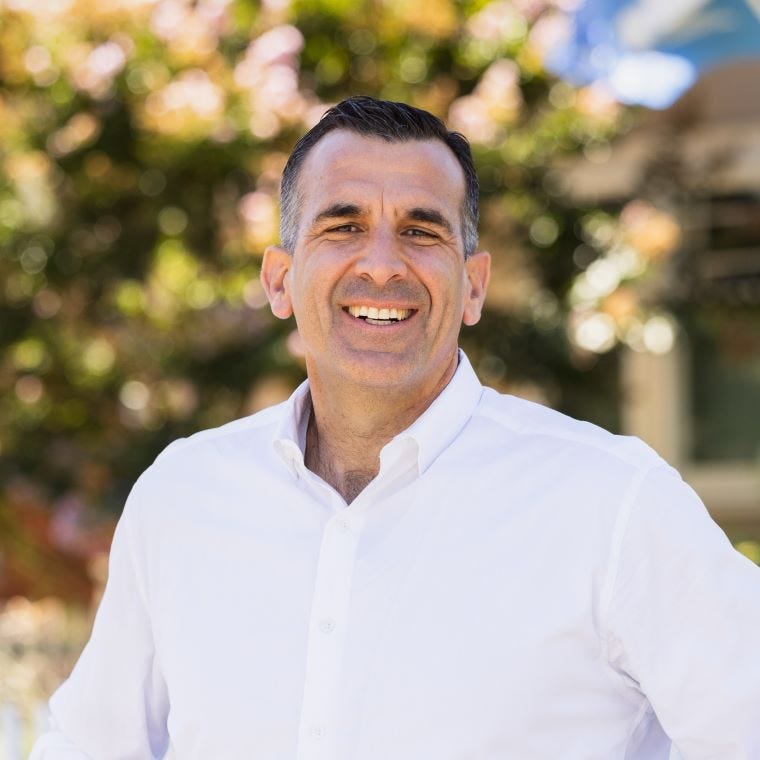
In this article, I’m going to summarize what happened when I tried this approach on my member of Congress Sam Liccardo who is a more typical member than Bill Foster.
My exchange with Rep. Liccardo
First off, let me say that I like Sam Liccardo. He’s a decent, hard working, talented, and smart guy.
The fact that Sam is engaging with me rather than blowing me off (like my former member of Congress Anna Eshoo) is evidence that he’s fundamentally a good human being. He has my respect for doing that.
My goal is to open his eyes to what is really going on here with respect to “follow the science” and vaccines in particular.
I’m going to summarize our conversation rather than quote it.
I wrote an email to Sam that we have 11 studies showing the unvaccinated are healthier and asked if he’d speak out about it in Congress and say that vaccine mandates are a bad idea because the State shouldn’t mandate a medical intervention that uniformly makes our children unhealthy. I cited the reanalysis of the Henry Ford study done by
He wrote back saying the first first two authors of the Henry Ford reanalysis study are experts in linguistics and that he relies on the advice of subject matter experts for forming his opinions on scientific matters. He wrote, “In the meantime, I’ll continue to follow my boring, uninteresting approach of heeding the counsel of trained, experienced medical doctors and epidemiologists who publish in peer-reviewed journals, and who openly and actively debate their findings. Those findings are far from infallible -- they’re routinely contested, as they should be. But they should be contested by scientists in their fields. I’m not ready to abandon the scientific method. When top doctors and epidemiologists conclude as you have, I’m happy to heed them.” He concluded “We’ll have to agree to disagree.”
I wrote back that the senior author was an epidemiologist, it was published in a peer-reviewed journal, and that critically, there are no errors in the paper. I addressed all the possible reasons he could reject the Henry Ford study.
I didn’t hear back so I wrote him again asking for a reply and suggested that he simply connect me with a scientist he trusts and we can have a conversation about it and report back.
He wrote back that he had a better idea: we should trust the peer-reviewed scientific literature. He said, “I have a better idea: let’s let the medical and scientific community identify the experts. Then they debate publicly—through peer reviewed journals, conferences, and subsequent studies. Steve, I’m not trying to be difficult or to duck a tough issue. This isn’t a tough issue for me—if the preponderance of the scientific community arrives at a conclusion, politicians like me should listen, and implement policy consistent with those conclusions. Otherwise, we should shut the hell up and stay out of it.”
I wrote back “You’ve set the standard: if the preponderance of the scientific community arrives at a conclusion, you implement policy consistent with it.
So let’s apply that standard. How does the scientific community ‘arrive at a conclusion’? It does so through its published, peer-reviewed work — that’s the only observable evidence a conclusion exists. And on the specific question of vaccinated vs. unvaccinated children, there are 11 published, peer-reviewed studies — Mawson (two studies, 2017), Hooker & Miller (SAGE Open 2020; JTS 2021), Lyons-Weiler & Thomas (2020), Lyons-Weiler (2022), Garner (2022), Enriquez (2005, Journal of Allergy and Clinical Immunology), and the others in my article. All 11 find the unvaccinated cohort is healthier. To my knowledge, there is no peer-reviewed vaxxed/unvaxxed study finding the opposite. So the preponderance of the published scientific record — 100% — points one way.
If ‘the scientific community’ arrives at conclusions by some other means than its published work, tell me what that means is, and who’s in it. Otherwise, the community has spoken, and the preponderance is unanimous.
What’s the next step?”
I’m waiting for a response and will update this article as I learn more.
My latest email to Rep. Liccardo sent on 9/14/26
Sam,
You proposed a better idea: let the scientific community identify the experts, and let them debate publicly through peer-reviewed journals, conferences, and subsequent studies. You framed this as deference to science — politicians stay out, experts sort it out, and you implement whatever conclusion emerges.
In response, I showed you in my previous email why this doesn’t change my original request because the published science shows vaccines are harming our kids.
But I also want to explain, respectfully, why that isn’t a better idea. It’s the mechanism by which inconvenient findings get killed.
Take a concrete case, because abstraction is how this always gets hand-waved.
Alzheimer’s disease is perhaps the most important disease of our lifetime in terms of cost to society.
Did the science journals get it right and RESOLVE whether aluminum is a major cause?
Answer: it absolutely did not. It’s crystal clear.
In 1992, a paper appeared in Nature — the most prestigious journal in the world — concluding there was no aluminium in the senile plaques of Alzheimer’s patients. It was treated as a landmark. It single-handedly ended the aluminium–Alzheimer’s hypothesis, and defunded the field for thirty years.
Here’s what actually happened. The instrument used in that study had a detection limit of roughly 10 ppm. It literally could not detect aluminium below that threshold. So “we found no aluminium” was really “our machine couldn’t see aluminium unless it was above 10 ppm.” The reviewers never asked. The editor never asked. When the flaw was pointed out afterward, the letters to Nature were ignored. The paper was “never going to fail” — not because it was right, but because it was useful.
That’s the system you’re proposing we trust. Peer review didn’t catch an elementary, checkable error in a flagship journal. The correction was suppressed. The flawed conclusion became “consensus,” and the scientist who actually did the experiment — Christopher Exley, who demonstrated in the lab that amyloid beta binds aluminium and refolds into exactly the form found in plaques — was ignored for thirty years.
So when you say “let the journals decide,” I have to ask: which journals? Nature decided, and Nature was wrong, and Nature never corrected itself. The peer-reviewed literature doesn’t referee the truth. It’s an arena where power and funding determine which findings survive.
Now apply that to the question in front of us. There are 11 published, peer-reviewed studies comparing vaccinated and unvaccinated children. All 11 find the unvaccinated cohort is healthier. There is no peer-reviewed vaxxed/unvaxxed study finding the opposite. Under your standard — the literature decides — the conclusion is already in, and it’s not the conclusion you’re comfortable with.
Here’s the part that worries me. I suspect your next move will be to tell me those 11 studies “don’t count” — wrong journals, contested methods, one was retracted. And that’s the Watt move. That’s exactly how the aluminium research was disappeared: drown the inconvenient finding in process objections, and call the silence “consensus.”
You don’t need journals to settle this.
You need experts who can actually read the methods and tell you whether the 11 studies were refuted or just buried. That’s what I proposed originally — a short, written exchange between experts, which you could read in an afternoon. You declined it in favor of a process that has a thirty-year track record of laundering industry conclusions into “science.”
I’m not asking you to become a scientist. I’m asking you to stop pretending the referee you’ve chosen is neutral. He isn’t. He was never going to fail.
Are you willing to name an expert you trust now?
-steve
From: Sam Liccardo <sam.liccardo@gmail.com>
Sent: Sunday, September 13, 2026 6:23 PM
To: Steve Kirsch <stk@skirsch.com>
Subject: Re: A simple process to resolve scientific issues
I have a better idea: let’s let the medical and scientific community identify the experts. Then they debate publicly—through peer reviewed journals, conferences, and subsequent studies.
Steve, I’m not trying to be difficult or to duck a tough issue. This isn’t a tough issue for me—if the preponderance of the scientific community arrives at a conclusion, politicians like me should listen, and implement policy consistent with those conclusions. Otherwise, we should shut the hell up and stay out of it.
Sam
Sam Liccardo
Member of Congress
16th District of California
(this email is being sent from my private account, and is not official correspondence)
On Sun, Sep 13, 2026 at 5:43 PM Steve Kirsch <stk@skirsch.com> wrote:
The simplest way to resolve issues like these is for you to identify an expert you trust on the topic area.
Then I (or a mutually agreeable expert) can have a short back in forth discussion in writing addressing the issue in an attempt to get to closure.
You then view the result.
Would that work for you?
-steve
Summary
By and large, members of Congress don’t really directly trust the science.
Instead, they listen to the advice of “medical experts” and believe those experts hook, line, and sinker.
That’s the mistake they are making.
I had proposed a reasonable approach that was actually suggested by ChatGPT which is for the member to facilitate a conversation with an scientific expert that the member trusts. Normally, such experts won’t give you the time of day, so that’s why having a member of Congress requesting the expert to engage is crucial.
Sam didn’t accept my suggestion; he went straight to “I follow the scientific literature.” That’s a corrupt system but Sam, like most people, is clueless about that. But I’ll work with what I’m given. The literature supports my point about vaccines. There are no unvaxxed/vaxxed studies showing the vaxxed are better off.
Stay tuned.
In the 2023–2024 cycle (his first congressional race), individuals affiliated with the Pharmaceuticals/Health Products industry gave about $109,850. These are personal donations from employees, executives, or their families - not direct checks from the companies themselves, which federal law prohibits. The broader Health sector (which includes pharma) also provided $11,500 in PAC contributions. So that's not a whole lot, but it's something.
Steve Kirsch— It's good to see a Congressman responding to a constituent, and to an independent journalist with such a large following as yours. As ever, I sincerely respect and appreciate your efforts to press this issue and to document the communications.
It seems to me that, like most people in my own circles, your Congressman is naive about the sausage-making-like workings of the medical and pharmaceutical industrial complex, and he probably considers himself judicious in sidestepping issues he doesn't feel professionally competent to handle.
I would suggest that, rather than attempt to educate him and argue with him about the science, much of which is going to zoom right over his head, or else would require more of his time than he's willing to spend on it, you might consider putting your focus on helping him to recognize that he is sidestepping his responsibilty in defending his constituents against the outrageous violation of their rights.
I'm not telling you anything you don't already know, but for anyone reading down here in the comments section— These violations include brutal censorship, especially during the jabs roll out— including of a large number of leading scientists, doctors, nurses and other experts, as well as citizens of all stripes. There is also the continuing existence of the PREP ACT, an egregious violation of due process. And grotesquely, the mass violation of informed consent. At the time the covid "vaccines" were rolled out, doctors did not know what was in them! The package inserts were labeled "INTENTIONALLY BLANK." Incredible, but true. Many people were killed and injured by these shots, as you know, but also, many people who did not comply lost their jobs. Where was their due process? Oh, and not to mention the violations of religious freedom.
But back to informed consent. This vital principle was established in the Nuremburg Codes, with which I'm quite sure he's already familiar. For many decades of my life I recall a lot of nattering, especially in Hollywood productions, about how we were all so much better than those nasty Nazis who did medical experiments on whomever they deemed apt to corral for the purpose.
Perhaps your Congressman might benefit from listening to some of Vera Sharav's interviews. For readers down here in the comments section, here's a handy link for an interview for VSRF made back in 2022: https://kirschsubstack.com/p/vsrf-today-at-4pm-pt-state-sanctioned
Is not the purpose of a Congressperson to represent his constituents and swear an oath to the US Constitution, which includes, of course, therefore, an oath to defend their rights?
One can argue with a Congressperson (or for that matter any one of my relatives, my neighbors and my ex-doctor) about "the science" until the sun comes up, but the question really is, is he fine with medical tyranny? Yes, keep the PREP Act? Yes, mandate jabs on citizens because someone in a white coat on TV says you should? It's fine to do whatever medical procedure to whomever because the "consensus" of "the science" says so? (My goodness, has he never seen a homeowners' association meeting?? And if a good portion of the participants were censored or excluded, how is their consensus a consensus?)
In short, is medical tyranny, which necessitates a violation of the US Constitution and its Bill of Rights, something he's fine with because [insert here reason du jour]? Why then, he can come out and say so, for the record.