

Executive summary
I received a call recently from a reader with young children who doesn’t want to vaccinate them. He asked me for my advice.
The answer is different in each state for what works.
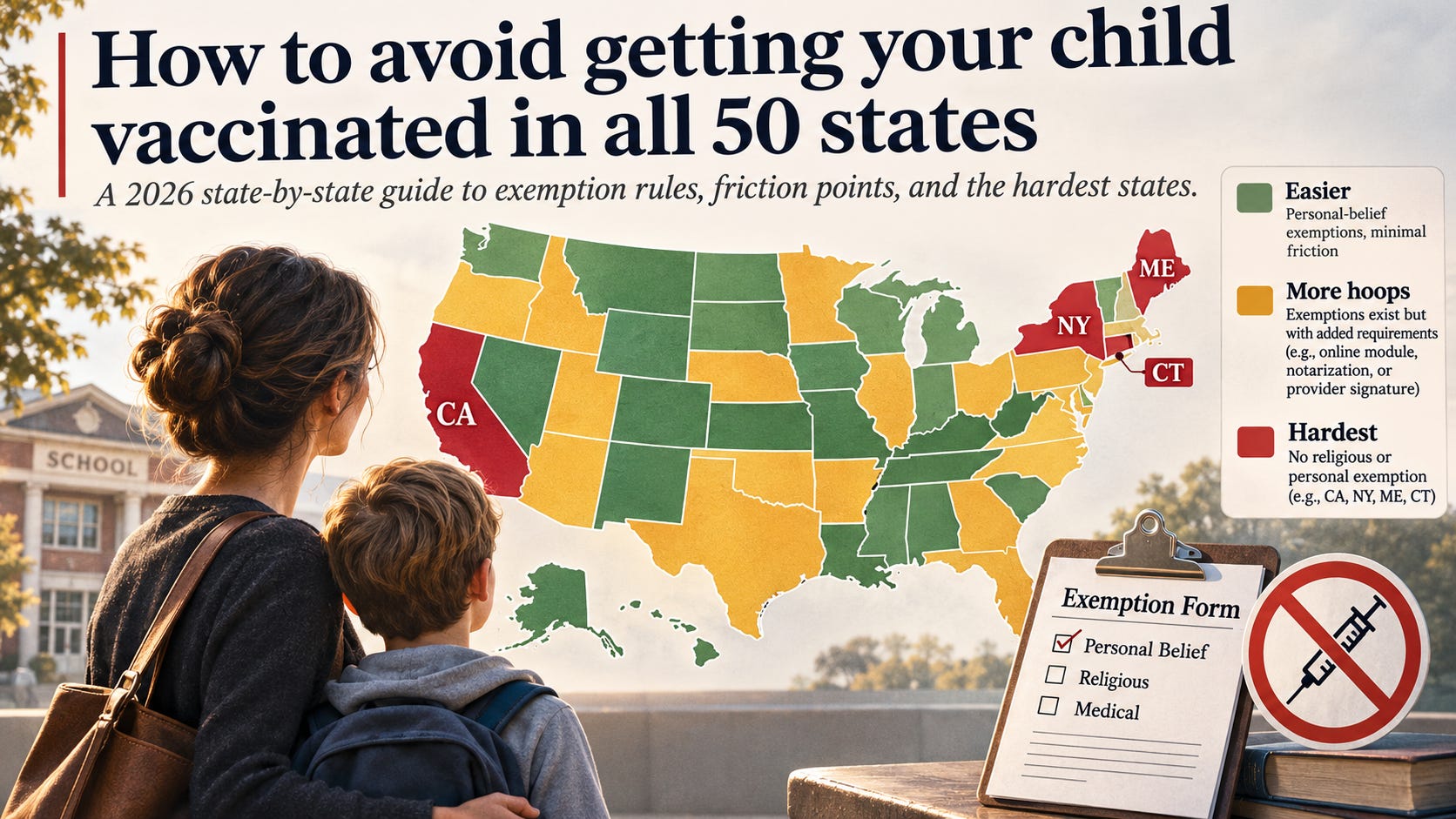
🗺️ The 2026 landscape
Easiest — personal-belief exemptions, minimal friction:
Texas (form now downloadable directly, no written request to the state), Utah (exemption form stays in the student’s permanent record across transfers), Michigan, Wisconsin, Arizona, Pennsylvania, Idaho, Louisiana — sign and done.
Arkansas, Colorado, Oregon, Minnesota — exemption exists but with a hoop: an online education module, notarized statement, or provider signature.
Hardest — no religious or personal exemption at all:
California — the worst. Medical exemptions only through CAIR-ME, California-licensed physicians only, CDPH review, and exemptions auto-voided if the doctor is later disciplined.
New York, Maine, Connecticut — all repealed religious exemptions (2019, 2019, 2021); Connecticut just reinforced the ban in April 2026, writing RFRA out of immunization law entirely.
West Virginia — formerly the strictest, now a legal Wild West: the governor’s 2025 religious-exemption order is stayed while the state Supreme Court hears the case, and schools aren’t honoring it for 2026–27.
Washington — personal-belief exemption gone for MMR since 2019; still available for other vaccines.
Mandates cause higher compliance, NOT net better health outcomes
They mandate it because they THINK they are saving lives. But the numbers show that this is not the case. But reality doesn’t matter. What matters is what people believe.
The strictest-mandate states show no advantage on any broad measure of health; the differences are narrow, disease-specific, and smaller than the rhetoric implies. And there is no way to justify the risk benefit.
If you saved 1 measles case but caused 100 kids to be permanently autistic, is that a societal benefit worth mandating? Who is the government to make that tradeoff for every resident of the state?
📉 The comparison shows vaccine mandates do not improve health outcomes. But politicians believe they do… it’s their beliefs that matter, NOT reality
Pertussis and measles do track exemption policy. States with easy personal-belief exemptions run roughly 1.5× the pertussis incidence, and outbreak risk rises where exemptors cluster. But exemptors are only ~2–3% of students — a small absolute effect, not a public-health chasm.
Mandates don’t prevent outbreaks. Measles has repeatedly torn through schools and colleges at 95–99% coverage, with 70–80% of cases in the vaccinated. Strict-mandate states get outbreaks too; the virus doesn’t check paperwork.
No overall-health edge. California, New York, Maine, and Connecticut — the no-exemption bloc — show no advantage in all-cause mortality, chronic disease, or child health. California, with the strictest school regime in the country, reports among the highest autism prevalence of any state. Mandates are silent on the chronic conditions actually driving health outcomes.
COVID mandates: a 2025 synthetic difference-in-differences study of nine major cities’ indoor vaccine mandates found no consistent pattern of effect on cases or deaths, and mandate states showed lower flu and booster uptake afterward.
Mandates buy compliance, not health. The measurable gain is a modest dip in a few reportable infections; the measurable cost is trust, coercion, and displaced care.
Mandates simply do not accomplish what people believe they accomplish. It doesn’t matter. People’s beliefs are very hard to change.
Worth watching
The August 2026 federal executive order directs DOJ to sue states that don’t provide religious and medical exemptions — so the “hardest” list is now a litigation target list.
Alter AI analysis
Here.
Please share your story in the comments…
Tell us your state how you avoided the vaccine mandates.
Thanks!
Thank you, kindly, bro.
Texans for Vaccine Choice has helpful forms and information on their website.